Clinisys wanted a single, discipline-agnostic Laboratory Information System instead of separate builds per specialty: identify what's shared across laboratory disciplines, design one experience for it, then layer in what's genuinely discipline-specific. I built the framework, and the research behind it, that made that judgment call possible across twelve laboratory domains.
Clinisys builds Clinisys Laboratory Solution (CLS) for laboratories spanning healthcare and scientific testing alike, including anatomic pathology, clinical pathology, genomics, reproductive medicine, environmental testing, pharmaceutical QC, and forensic science. Building each discipline as its own product would have been slower and more fragmented than the business could sustain. The goal instead was one agnostic application: find what's genuinely shared across disciplines, design that once, and reserve discipline-specific design for where the work actually diverges.
That's a research problem before it's a design problem. You can't decide what to share until you know, in detail, what a pathologist, a genomics scientist, an environmental chemist, and a lab director each actually do. I ran weekly SME interviews and workshops over several months and used the findings to build a four-lens analytical framework (who does the work, what the work touches, how the work happens, and what the system needs to support it), which then became the standing interview guide for the rest of the project.
Applying that framework produced a role map spanning sixteen role families, a taxonomy of twelve laboratory domains, fifteen distinct workflow models, and twenty-nine discipline-specific application flows: the concrete, buildable evidence of where CLS could share one experience and where it needed to branch.
This was systems research: understanding a domain well enough to know what could safely be generalized. The framework came first, built from early SME conversations, then served as the interview guide for everything after, so every subsequent workshop was structured around the same four questions: who's doing this, what are they working with, how does the work actually happen, and what does the system need to do about it.
CLS needed to support laboratory disciplines that, on the surface, have almost nothing in common. A pathologist reading tissue under a microscope and an environmental chemist testing water samples don't look like the same job. But underneath the domain-specific vocabulary, both are moving material through receipt, processing, testing, interpretation, and reporting, with results that need to be traceable back to their source. The challenge was proving that structural similarity existed, and precisely enough to act on it, before any application design decision could be made with confidence.
Before any discipline-specific research began, four lenses were established as the guide: the same four questions asked in every SME interview and workshop that followed, across every discipline, for months. Who is doing the work, what are they working with, how does the work happen, and what does the system need to support it.
Which user/role performs this activity. That question was carried into every interview, answered in full once the roles were mapped (see Who Does the Work, below).
The core things the laboratory needs to track, and the relationships between them:
What relationships and states matter as a sample moves through an object lifecycle:
and through operational states:
What process the user is performing: the steps, decisions, handoffs, and exceptions. At the highest level, one process held across every discipline:
Workflows that recur throughout the lifecycle, rather than at a single point, were also identified:
The high-level process could often be shared while the activities underneath it differed significantly by discipline. Sample Preparation, for example, could mean aliquoting a blood sample, embedding and sectioning tissue, extracting DNA, or preparing an environmental sample for instrumental analysis.
What the system needs to provide: automation, validation, integrations, permissions, notifications, and traceability, among others.
Is this shared across disciplines, or different, and what causes the difference? Is it the science, the workflow, the sample type, a regulation, the instrumentation, an organizational model, or another business rule? That question doesn't get answered in the abstract. It gets answered flow by flow, in the application flows below.
People, not screens, were the first lens, because what's shareable in an interface depends entirely on who's using it and what they're accountable for. Sixteen role families emerged across every domain, which I grouped into four functional categories:
| Role Family | What They Do | Examples |
|---|---|---|
| Laboratory Technician / Technologist | Performs routine specimen preparation, testing, instrument operation, QC, and result documentation according to established procedures. | Lab Technician, Medical Laboratory Technician (MLT), Medical Laboratory Scientist/Technologist (MLS/MT) |
| Specialist Technologist | Performs technically specialized laboratory work requiring domain-specific expertise. | Histotechnologist, Cytotechnologist, Microbiology Technologist, Molecular Technologist, Cytogenetic Technologist |
| Pathologist / Physician | Provides medical oversight, interprets laboratory findings, establishes diagnoses, and authorizes clinical reports where required. | AP Pathologist, Clinical Pathologist, Hematopathologist, Molecular Pathologist |
| Pathologists' Assistant | Performs and documents gross examination, specimen dissection, tissue selection, and other AP activities under pathologist supervision. | Pathologists' Assistant |
| Scientist / Researcher | Designs and conducts experiments, develops methods, analyzes data, and interprets scientific findings. | Scientist, Research Scientist, Molecular Biologist |
| Clinical / Scientific Specialist | Provides advanced interpretation and subject-matter expertise within a specialized testing domain. | Clinical Scientist, Clinical Chemist, Clinical Microbiologist, Geneticist |
| Bioinformatics / Data Scientist | Processes, analyzes, interprets, and manages complex laboratory datasets, particularly genomic and other high-dimensional data. | Bioinformatician, Computational Biologist, Variant Scientist |
| Quality / Compliance | Manages laboratory quality systems, audits, nonconformances, documentation, accreditation, and regulatory compliance. | Quality Manager, QA Specialist, Compliance Officer |
| Laboratory Manager / Supervisor | Oversees day-to-day laboratory operations, staffing, workload, resources, quality, and operational performance. | Section Supervisor, Lab Manager, Operations Manager |
| Laboratory Director | Holds overall scientific, clinical, regulatory, and/or operational responsibility for the laboratory. | Laboratory Director, Medical Director, Scientific Director |
| Specimen / Accessioning Staff | Receives, identifies, registers, labels, routes, tracks, and prepares specimens for laboratory workflows. | Accessioner, Specimen Processor, Sample Coordinator |
| Phlebotomist / Collection Staff | Collects patient specimens and ensures correct patient identification, labeling, and specimen handling. | Phlebotomist, Collection Technician |
| Application / LIS Administrator | Configures and maintains laboratory applications, users, workflows, rules, dictionaries, reports, and application-level integrations. | LIS Administrator, LIMS Administrator, Application Analyst |
| Systems / Integration Specialist | Maintains technical infrastructure and interfaces connecting laboratory applications, instruments, middleware, EHRs, and other systems. | Systems Administrator, Interface Analyst, Integration Engineer |
| IT / Informatics Leadership | Defines laboratory informatics architecture, governance, security, interoperability, and technology strategy. | Laboratory Informatics Manager, IT Manager |
| Administrative / Support Staff | Supports scheduling, documentation, billing, customer service, records, logistics, and other non-testing laboratory activities. | Administrative Assistant, Client Services, Billing Specialist |
The same functional categories (bench, authority, leadership, systems) recurred in every domain, even though the specific titles inside them didn't. That consistency is what made a shared permissions and role model possible in the first place.
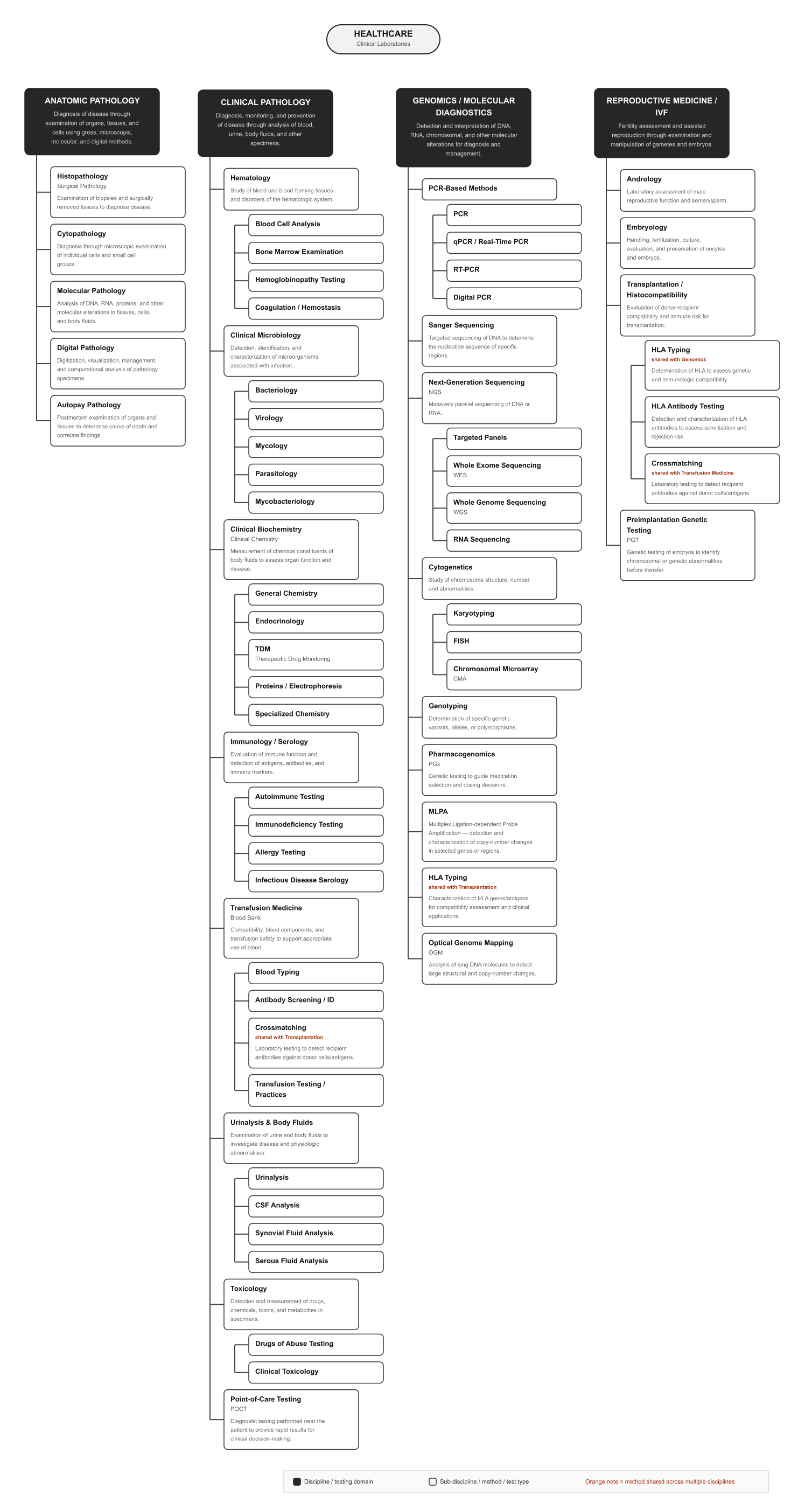
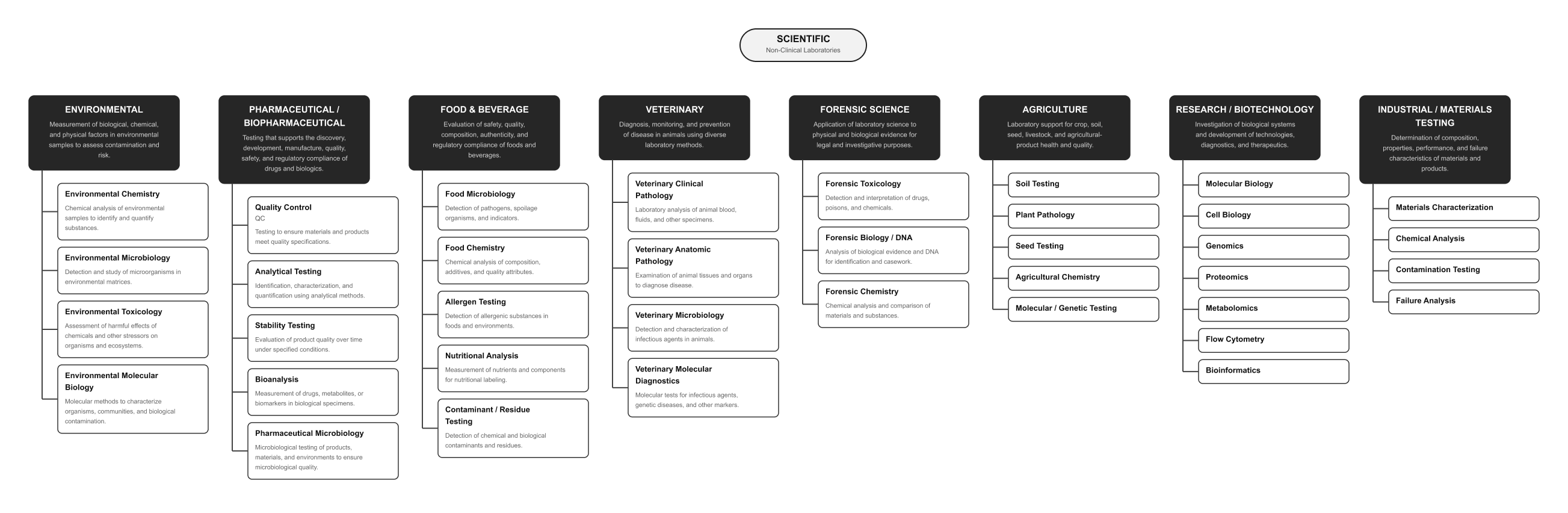
The taxonomy splits into two businesses: four healthcare domains (Anatomic Pathology, Clinical Pathology, Genomics/Molecular Diagnostics, Reproductive Medicine/IVF) and eight scientific domains (Environmental, Pharmaceutical/Biopharmaceutical, Food & Beverage, Veterinary, Forensic Science, Agriculture, Research/Biotechnology, Industrial/Materials Testing). Each domain breaks down into sub-disciplines and methods, down to specific test types like NGS or PCR variants, giving the taxonomy enough resolution to actually drive design decisions rather than stay abstract.
A handful of methods, including Crossmatching and HLA Typing, sit at the intersection of multiple domains (Transfusion Medicine, Transplantation, Genomics), flagged directly in the taxonomy as shared. Those intersections were an early, concrete signal of where a shared interface pattern could work across otherwise distinct disciplines.
With roles and domains mapped, the next question was process: does the work follow the same shape across disciplines, or does it fundamentally diverge? Investigating how each discipline actually operates, their purpose, testing methods, samples, terminology, and major activities, came directly from the same weekly SME interviews and workshops used throughout this research, not from documentation alone. The output was a working library of fifteen laboratory workflow models, each one mapped to the specific specialties it applies to, with its own typical step sequence:
| Workflow Model | Primarily Applies To | Typical Flow |
|---|---|---|
| 1. Histopathology / Surgical Pathology | Histopathology, Surgical Pathology | Accession→Grossing→Processing→Embedding→Microtomy→Staining→Slide Review→Diagnosis→Report→Archive |
| 2. Cytopathology | GYN Cytology, Non-GYN Cytology, FNA | Accession→Specimen Preparation→Staining→Screening/Review→Pathologist Review→Diagnosis→Report→Archive |
| 3. Clinical Laboratory | Chemistry, Hematology, Immunology, Urinalysis | Order/Accession→Collection/Receipt→Preparation→Analyzer/Testing→QC→Result Validation→Report |
| 4. Clinical Microbiology | Bacteriology, Mycology, Mycobacteriology | Accession→Specimen Processing→Culture/Inoculation→Incubation→Detection/Identification→AST→Interpretation→Report |
| 5. Molecular Diagnostics / PCR | PCR, qPCR, RT-PCR, dPCR | Accession→Sample Preparation→Nucleic Acid Extraction→Amplification→Detection→Analysis/QC→Interpretation→Report |
| 6. Sequencing | Sanger, NGS, WES, WGS, RNA-seq | Accession→Extraction→Library/Template Preparation→Sequencing→QC→Bioinformatics→Variant Interpretation→Report |
| 7. Cytogenetics | Karyotyping, FISH, CMA | Accession→Sample Preparation/Culture→Assay→Imaging/Scanning→Analysis→Interpretation→Report |
| 8. Flow Cytometry | Clinical/Research Flow Cytometry | Accession→Cell Preparation→Antibody Staining→Acquisition→Gating/Analysis→Interpretation→Report |
| 9. Transfusion Medicine | Blood Bank | Order→Patient/Specimen Identification→ABO/Rh→Antibody Screen→Component Selection→Crossmatch→Issue→Transfusion→Reaction Investigation |
| 10. Transplant / Histocompatibility | HLA, antibody testing, transplant crossmatch | Donor/Recipient Registration→Specimen→HLA/Antibody Testing→Crossmatch→Compatibility Assessment→Clinical Interpretation→Report |
| 11. Toxicology | Clinical/Forensic Toxicology | Accession→Preparation→Screening→Confirmation→Quantitation→Review/Interpretation→Report |
| 12. IVF / Embryology | Andrology, Embryology, IVF | Patient/Cycle→Gamete Collection→Preparation→Fertilization→Culture→Assessment→Transfer/Cryopreservation→Outcome Documentation |
| 13. Environmental / Food / Industrial Testing | Environmental, Food, Agriculture, Materials | Sample Registration→Chain of Custody→Preparation→Test/Analysis→QC→Technical Review→Certificate/Report→Sample Disposal/Retention |
| 14. Pharmaceutical QC | Pharma/Biopharma QC | Sample/Lot Registration→Sampling→Preparation→Testing→QC→Review→Approval/Release→Stability/Retention |
| 15. Research / Biotechnology | Research labs | Study/Experiment Setup→Sample Registration→Preparation→Experimental Procedure→Data Acquisition→Analysis→Review→Data/Result Storage |
Four of these models (Transplant/Histocompatibility, IVF/Embryology, Pharmaceutical QC, and Research/Biotechnology) sit outside disciplines Clinisys applications currently support. That was a real gap in the original taxonomy, though not one this framework needs to solve: it only matters if Clinisys builds or acquires into those disciplines, and until then it doesn't change how the framework applies to the businesses it serves today.
Comparing those fifteen models stage by stage, across four representative domains, made the shared-versus-specific pattern explicit. The same nineteen stages run through every discipline; what changes is the vocabulary, the artifacts, and where the emphasis sits.
| Workflow Area | Anatomic Pathology | Clinical Pathology | Genomics | Scientific |
|---|---|---|---|---|
| Request / Order | Patient case / pathology procedure initiates work | Patient test order initiates work | Test/assay request initiates work; may include clinical or research context | Request may be tied to customer, project, study, sample, batch, or method |
| Collection | Often occurs as part of a clinical procedure; tissue/cells collected | Common and patient-centric; blood, urine, swabs, body fluids, etc. | Clinical or research sample collection; requirements depend on molecular assay | Can be field, production, facility, or laboratory collection; sampling context can be significant |
| Transport | Tissue/specimens, blocks, or slides may move between locations/labs | Patient specimens frequently transported to lab/reference lab | Samples/extracts may require controlled transport | Samples may require shipment tracking, preservation, chain of custody, and transport-condition documentation |
| Receiving | Accession specimen and associate it with patient/case | Accession and match specimen to patient/order | Accession sample and associate with request/assay | Receive sample and associate with request/customer/project/study |
| Processing / Preparation | Grossing→fixation→tissue processing→embedding→sectioning→staining | Centrifuge→separate→aliquot→dilute / other preparation | Extraction→quantification/QC→normalization→assay/library preparation | Method-dependent: weigh→homogenize→extract→digest→filter→dilute→culture, etc. |
| Derived Material | Specimen→cassette→block→slide | Specimen may remain the same or create aliquots/derivatives | Sample→extract→library→pool | Sample may create aliquots, extracts, digests, cultures, or other preparations |
| Testing / Execution | Microscopy plus ancillary testing such as stains/IHC/ISH | Automated analyzer or manual testing | PCR, molecular assays, sequencing | Analytical method / experiment; instrument or manual |
| How Work Is Grouped | Case, processor/stain run | Test, analyzer rack/batch | Plate, assay, pool, sequencing run | Method, batch, run, worklist |
| Raw Output | Morphology / image / observation | Instrument measurement or manual result | Signals, reads, sequence/run data | Measurements, observations, analytical data |
| QC | Tissue, section, and stain quality | Controls, calibration, analyzer/test QC | Multiple QC points: extraction, library, assay/run, sequence/data | Controls, blanks, standards, system suitability, method/batch QC |
| Analysis | Morphologic assessment and correlation | Calculations, reference ranges, flags, rules | Bioinformatics / computational analysis | Quantitation, calculations, statistics, data analysis |
| Interpretation / Review | Pathologist diagnosis is central | Technical validation; clinical interpretation when required | Scientific/clinical interpretation of molecular findings is central | Scientific/technical review; interpretation depends on purpose of testing |
| Result | Diagnosis / findings | Patient test result | Molecular/genomic finding + interpretation | Analytical result, determination, or conclusion |
| Reporting | Diagnostic report; narrative + structured content | Often structured results released directly to downstream clinical systems | Structured findings + interpretive report/data | COA, analytical report, study result, dataset, or customer/regulatory output |
| Corrections After Release | Addendum / amended report | Corrected result | Amended report / reinterpretation | Revised/corrected result or report |
| Storage | Tissue, blocks, and slides | Specimens and aliquots | Samples, extracts, libraries, and data | Samples, preparations, extracts, materials, and data |
| Retrieval / Reuse | Review, recut, additional stains/testing | Add-on or repeat testing | Retest, rerun, reanalysis | Retest, investigation, additional analysis |
| Disposal | Tissue/material disposal according to retention requirements | Specimen/biohazard disposal | Sample/material disposal according to applicable requirements | Material-specific disposal and regulatory requirements |
| Traceability Emphasis | Patient→case→specimen→cassette→block→slide | Patient→order→specimen→test→result | Sample→derivatives→run→data→finding | Sample/material→preparation→method/batch/run→result |
The last row makes the pattern explicit: every domain traces the same underlying question (where did this come from, and what happened to it) through a completely different vocabulary. That's the shared spine the whole framework was built to protect, discipline-specific nouns and all.
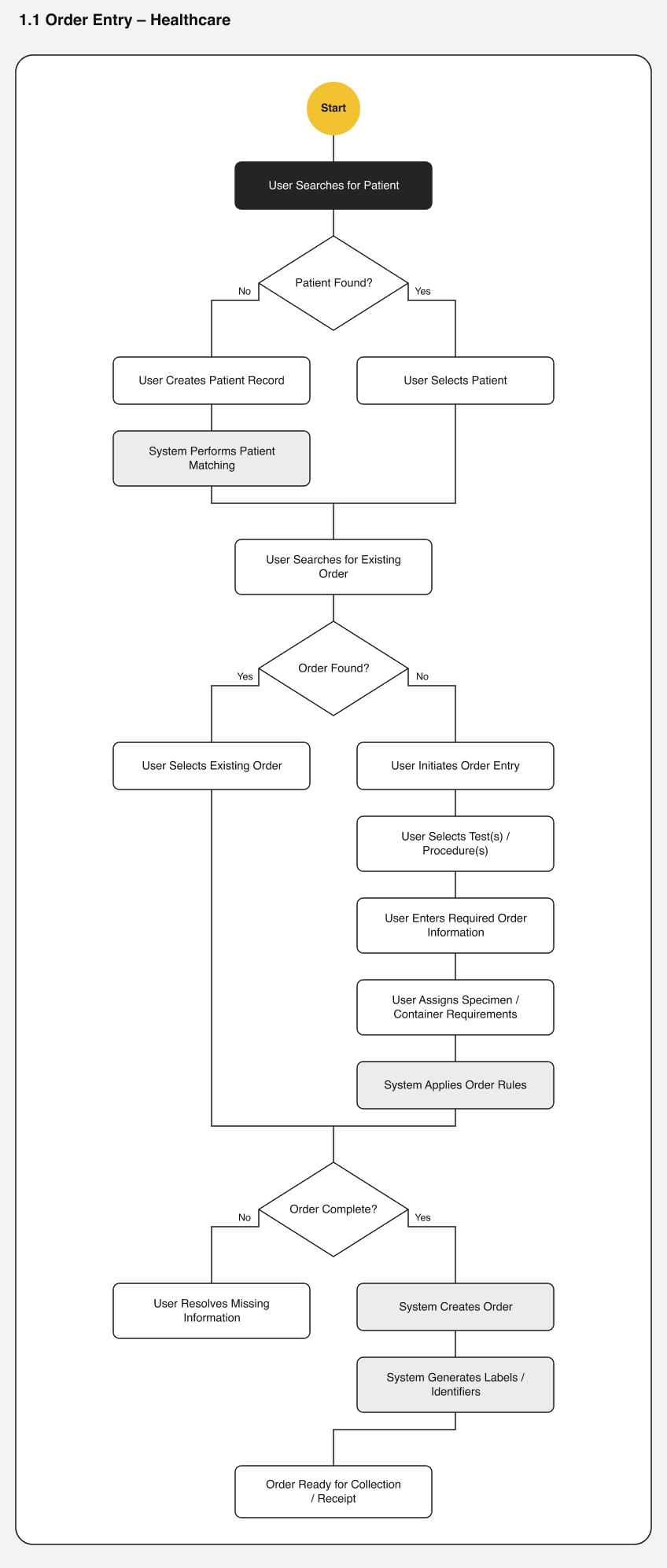
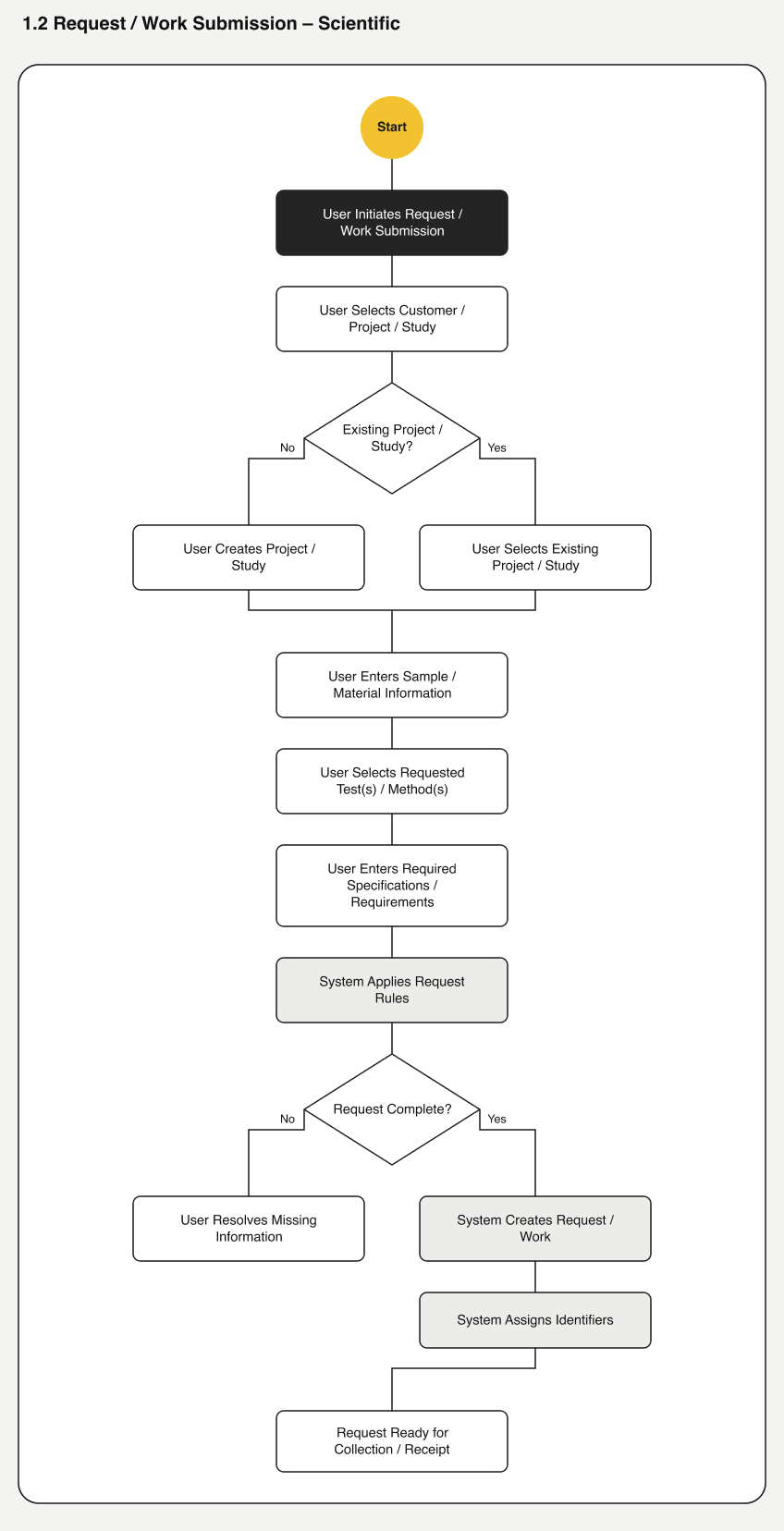
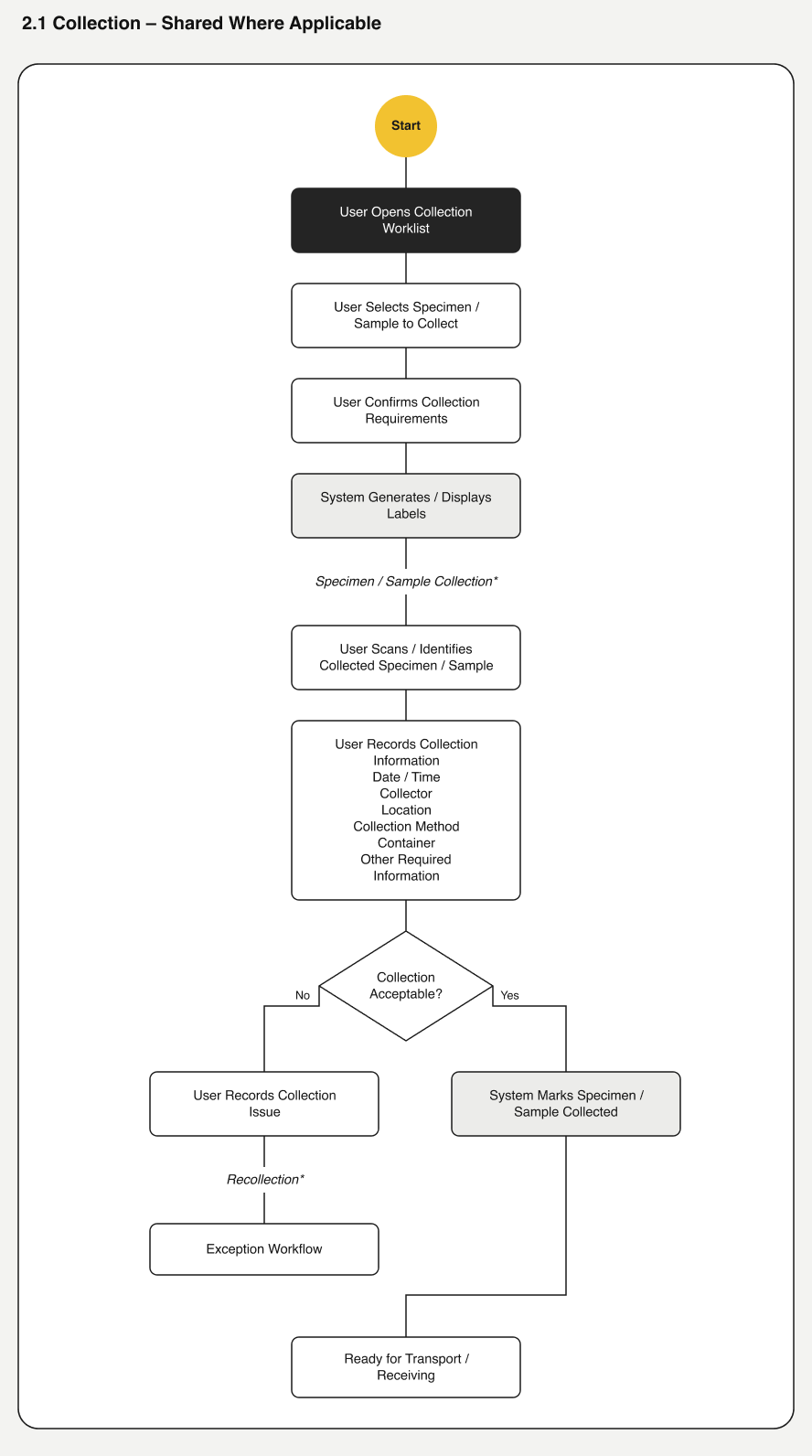
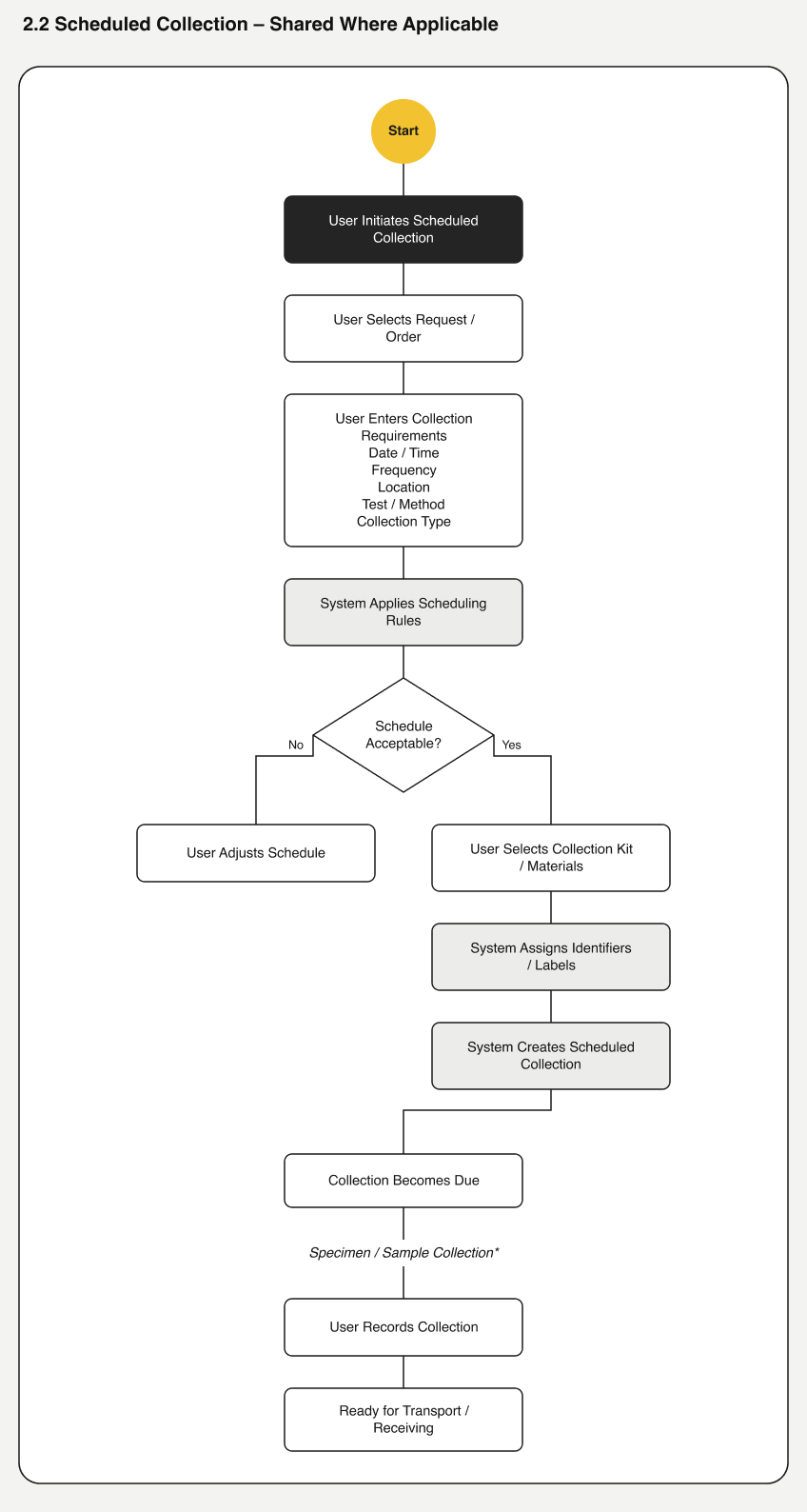
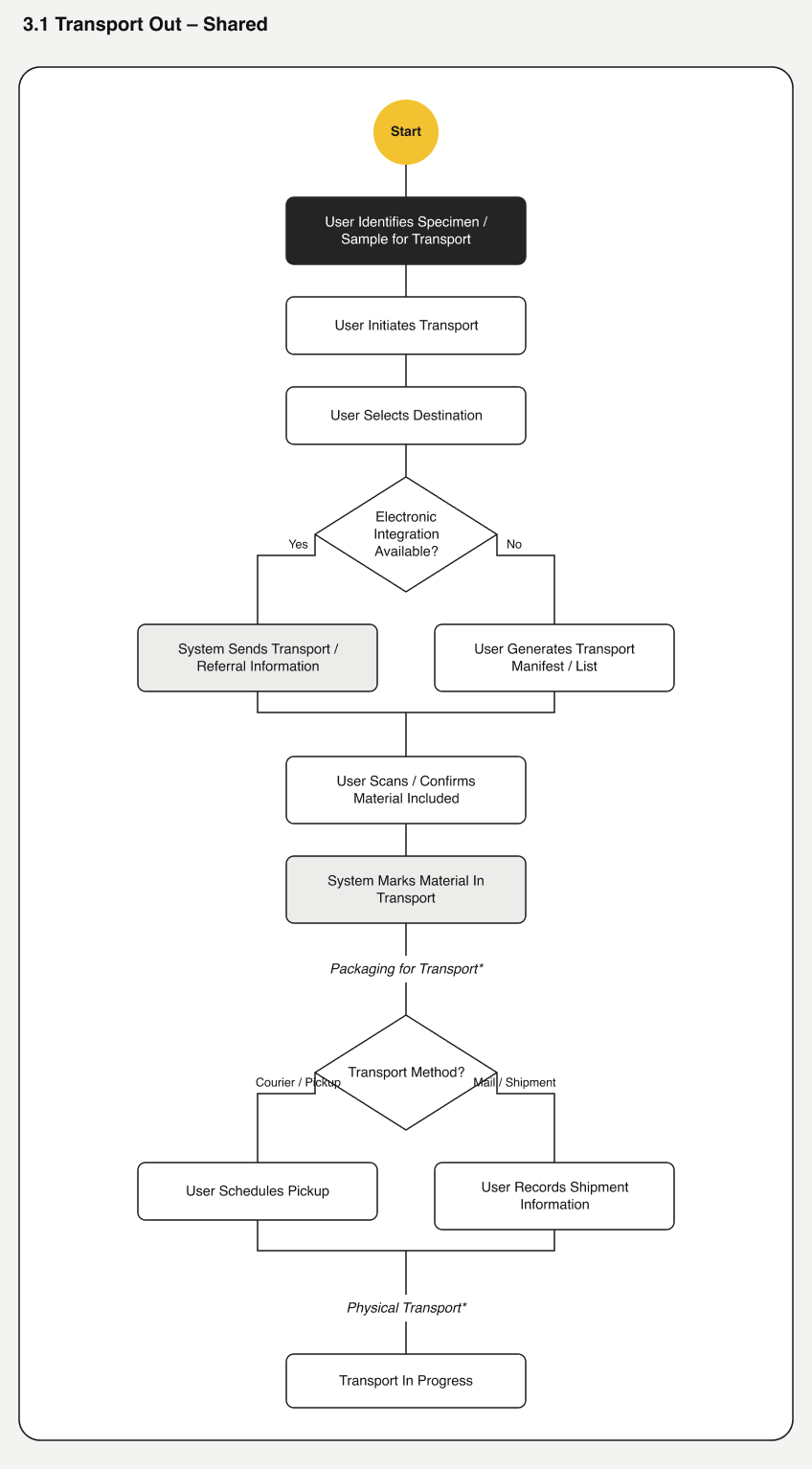
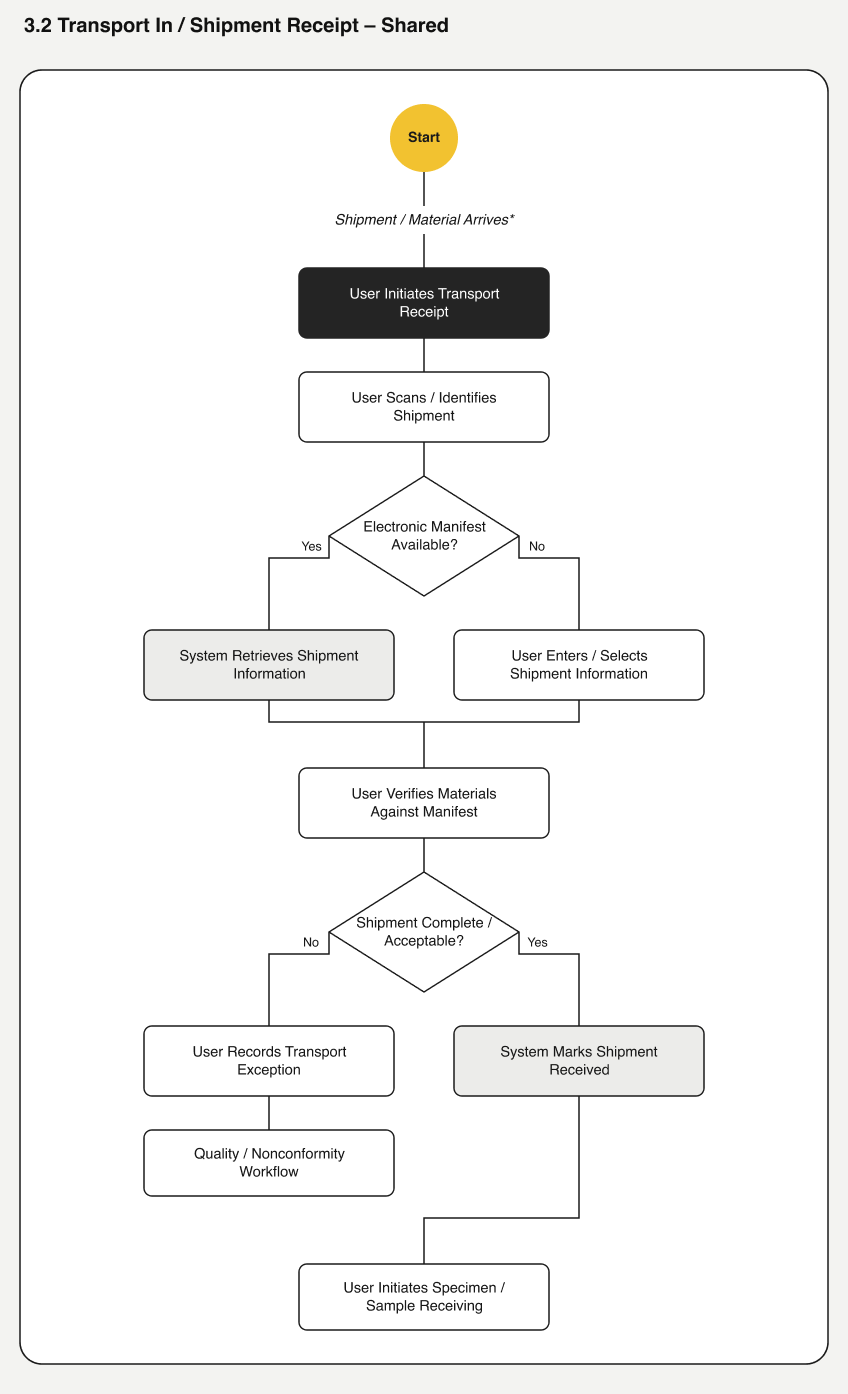
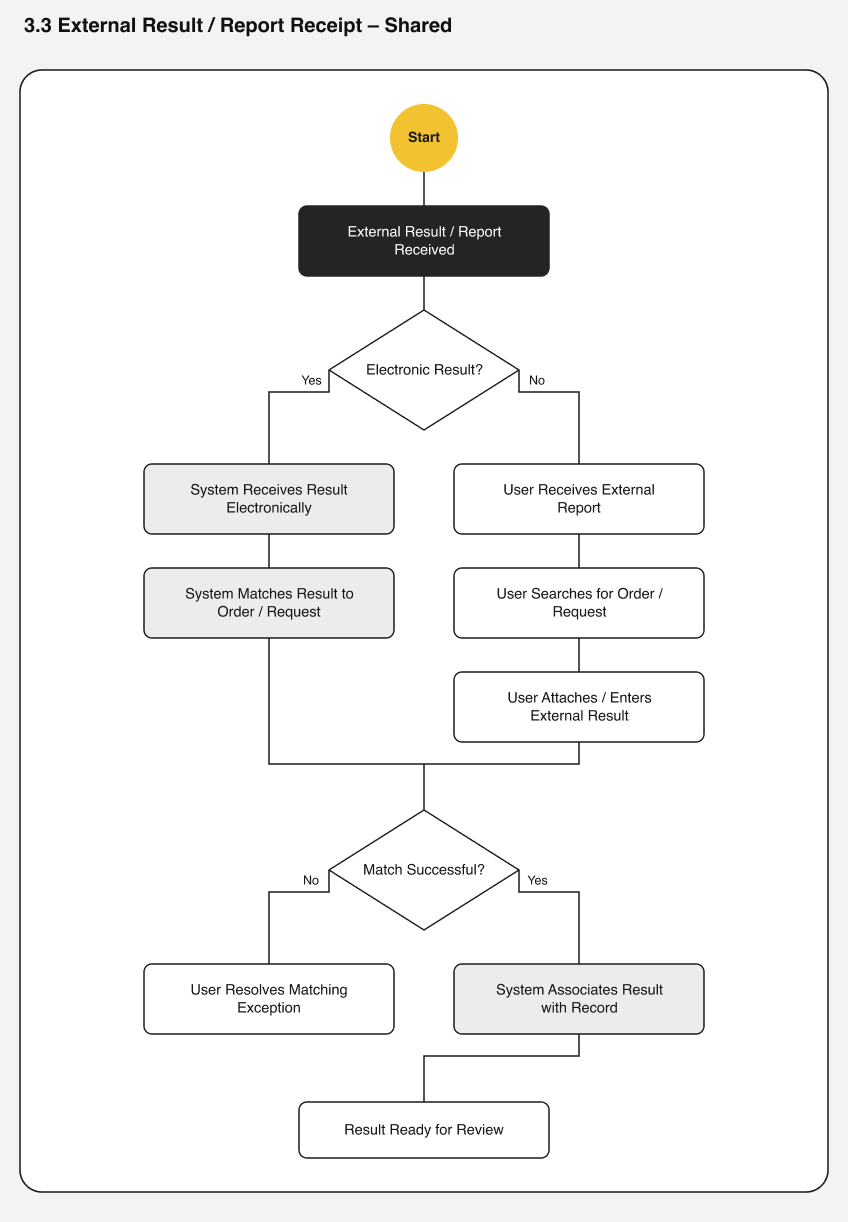
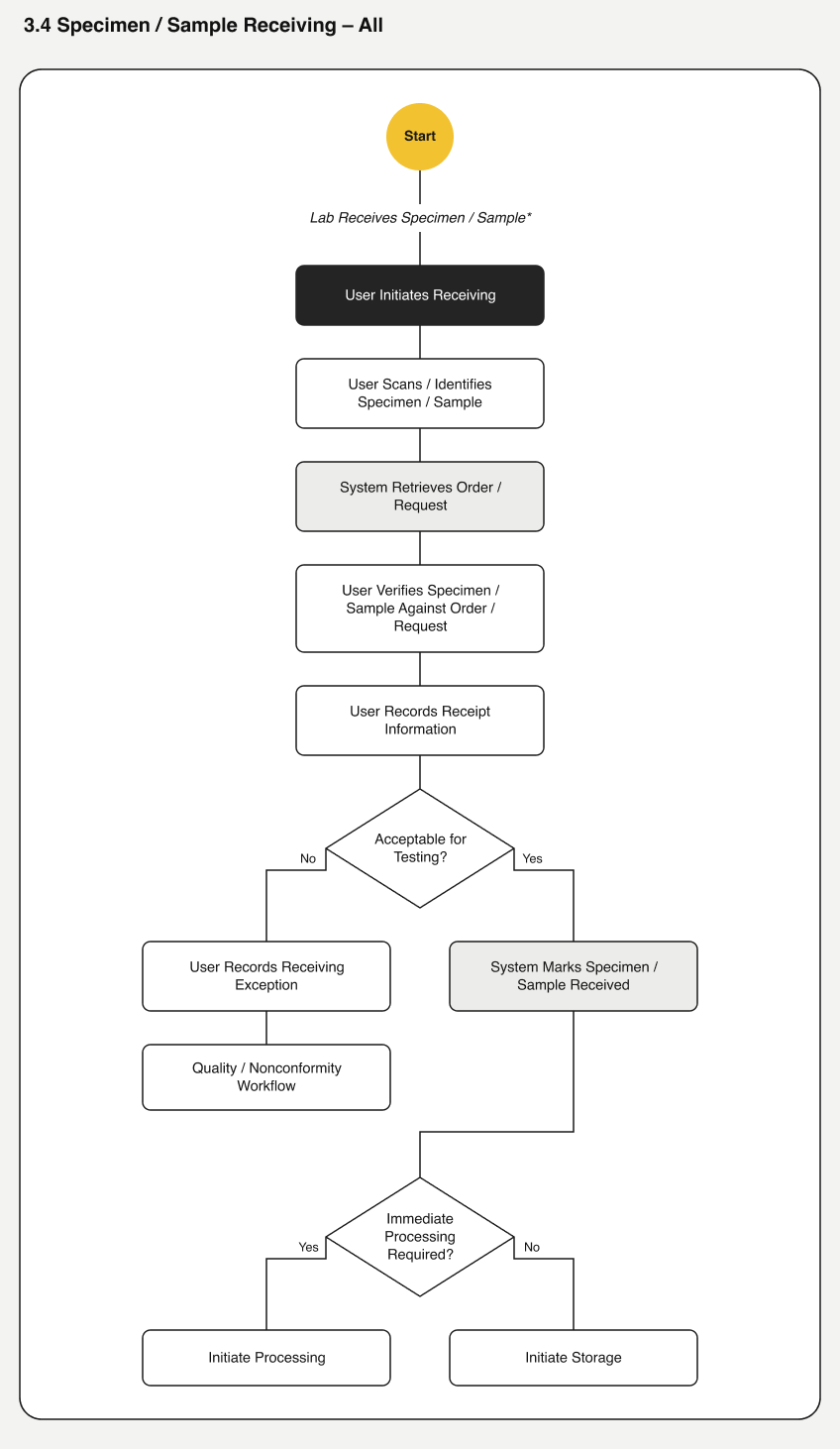
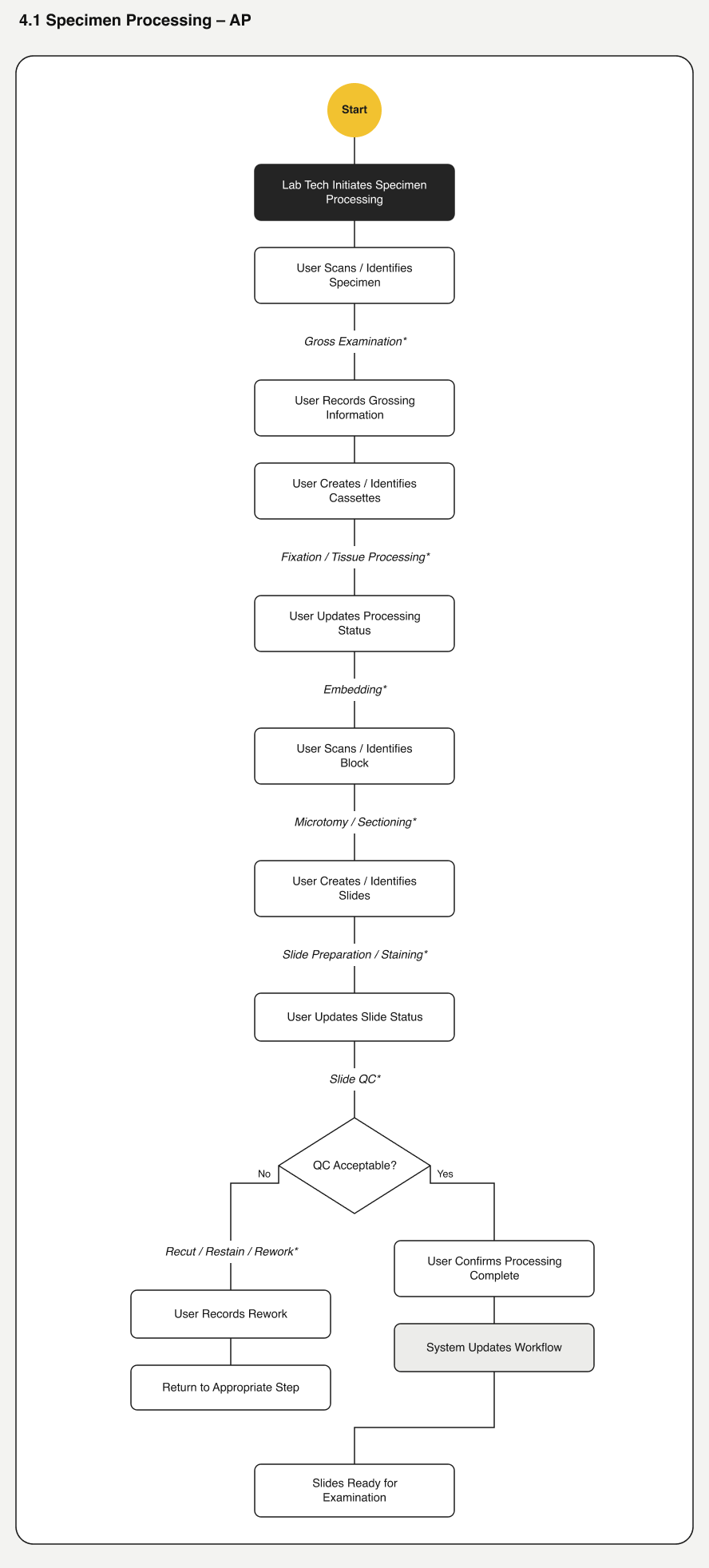
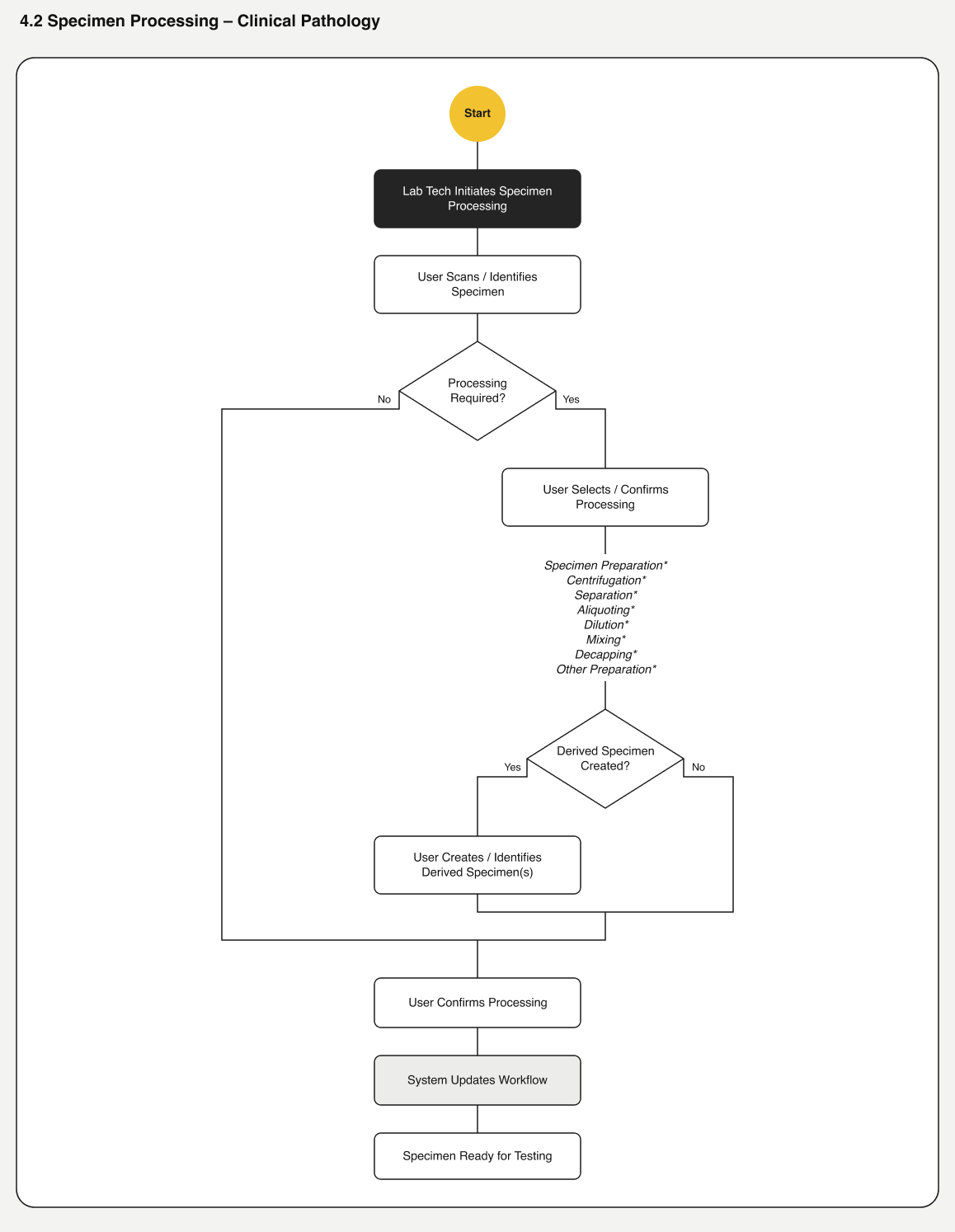
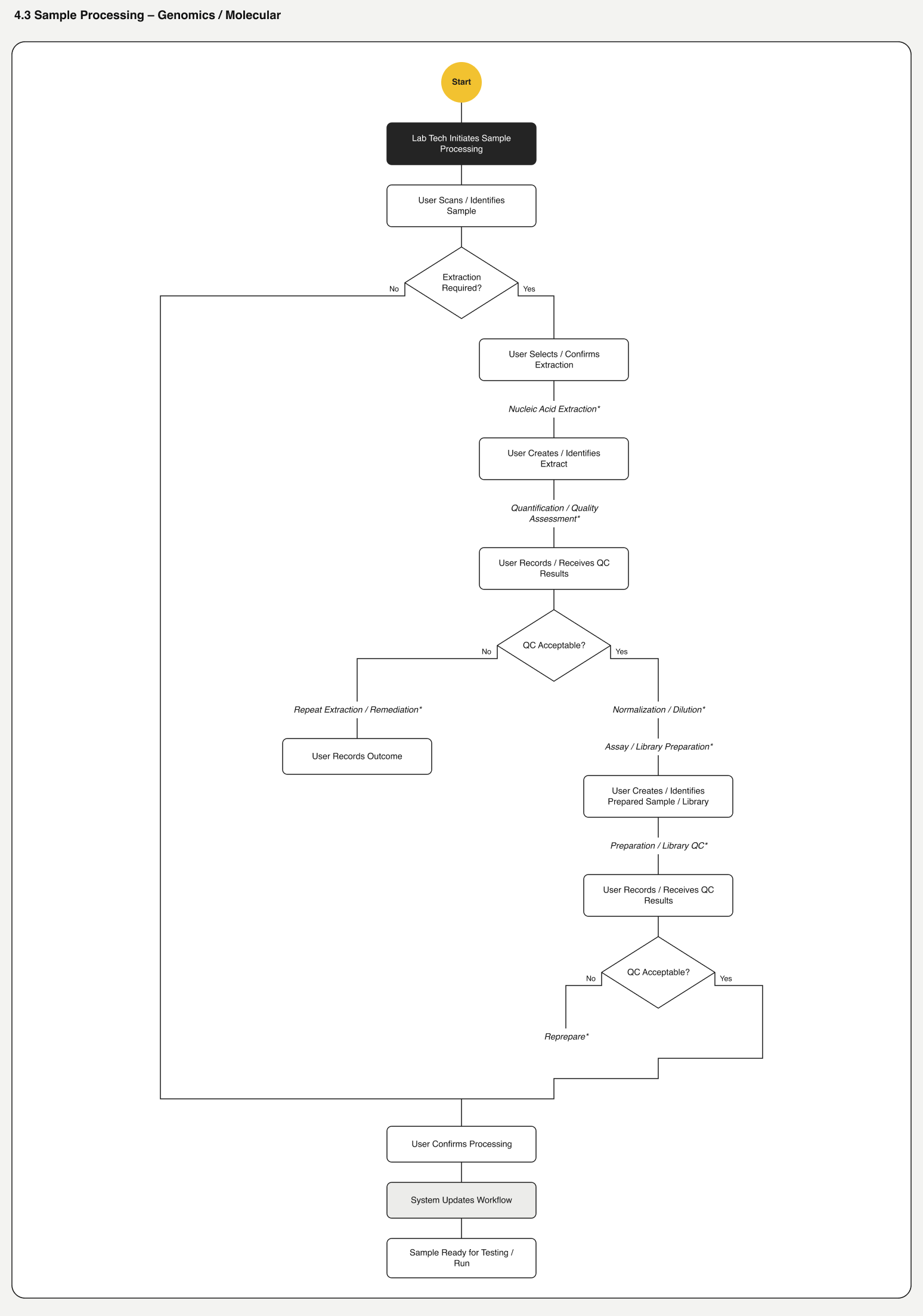
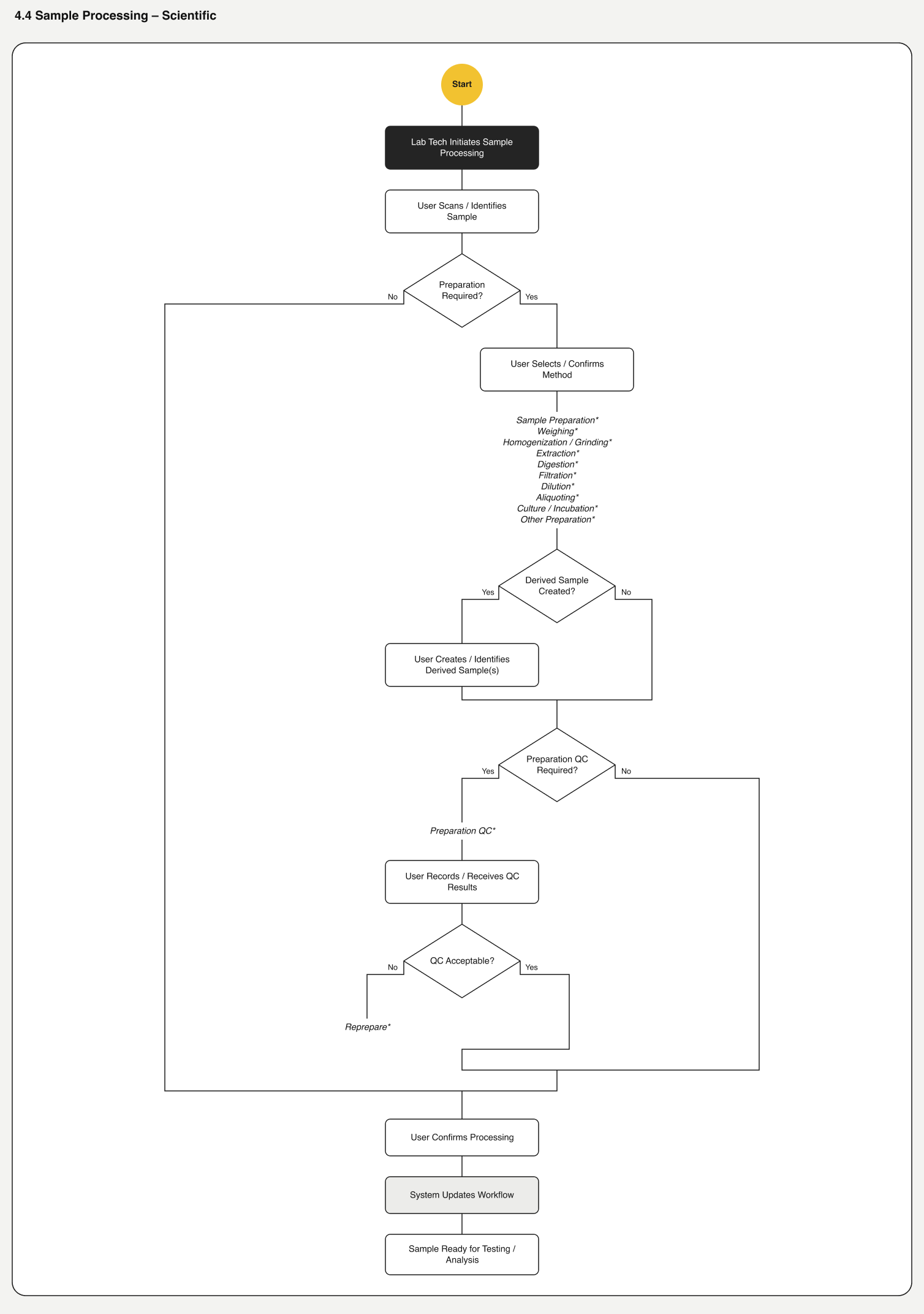
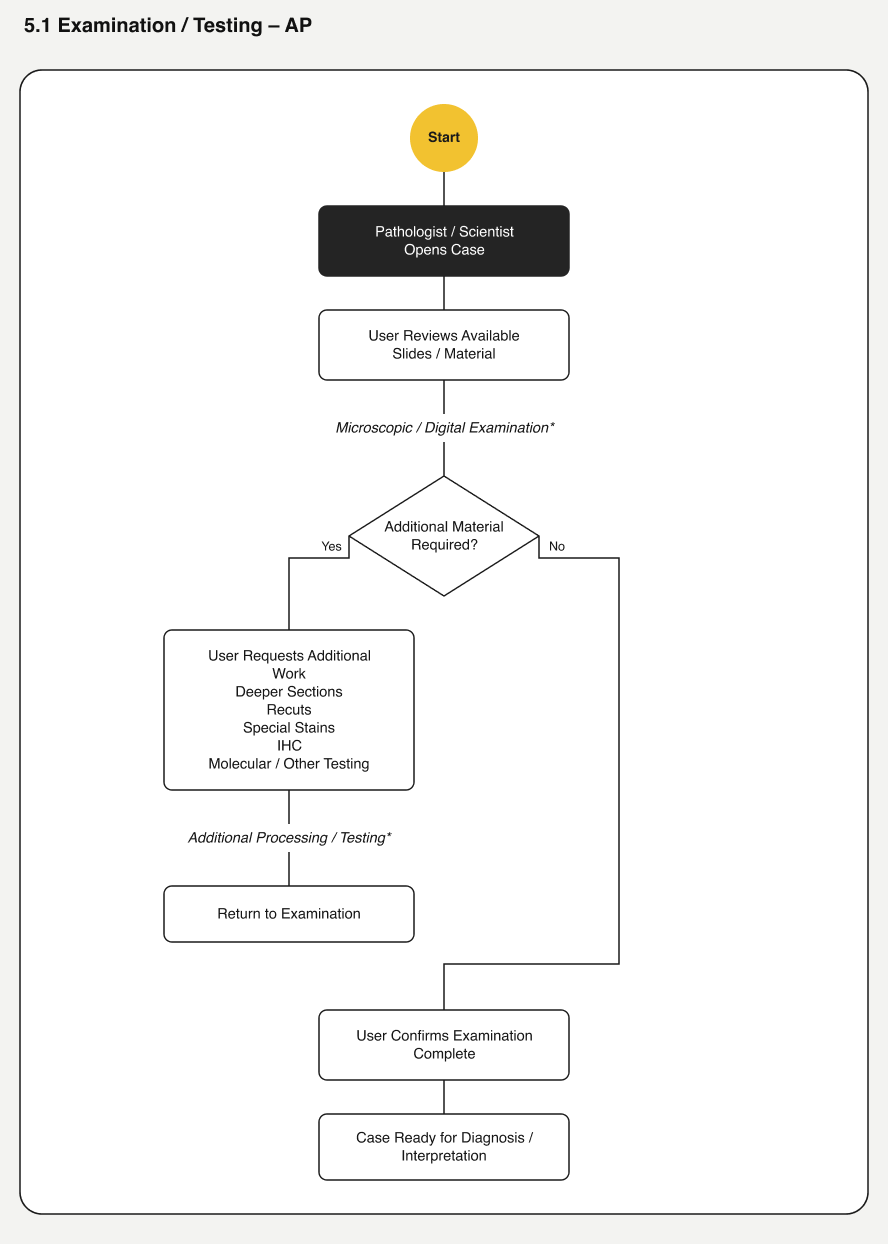
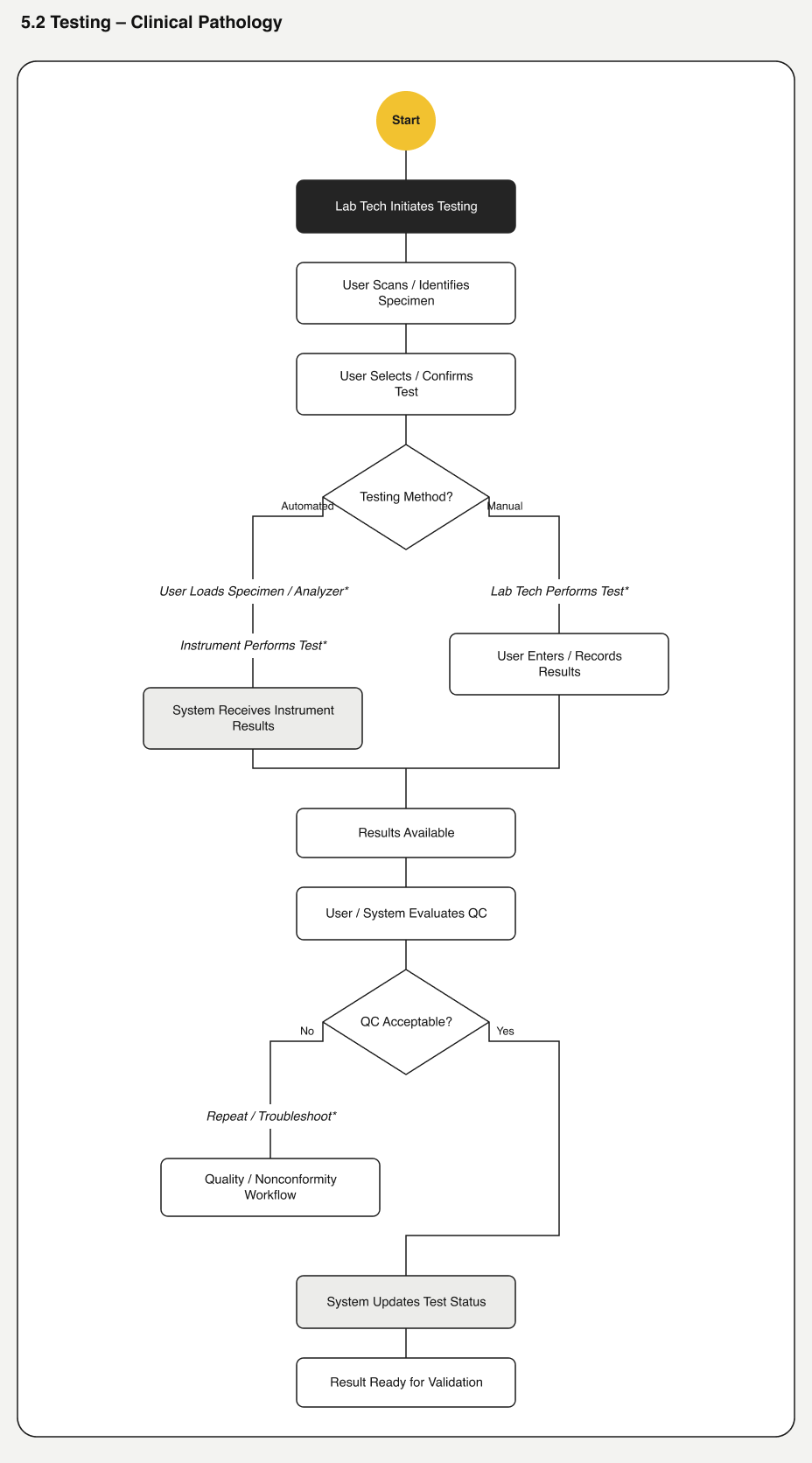
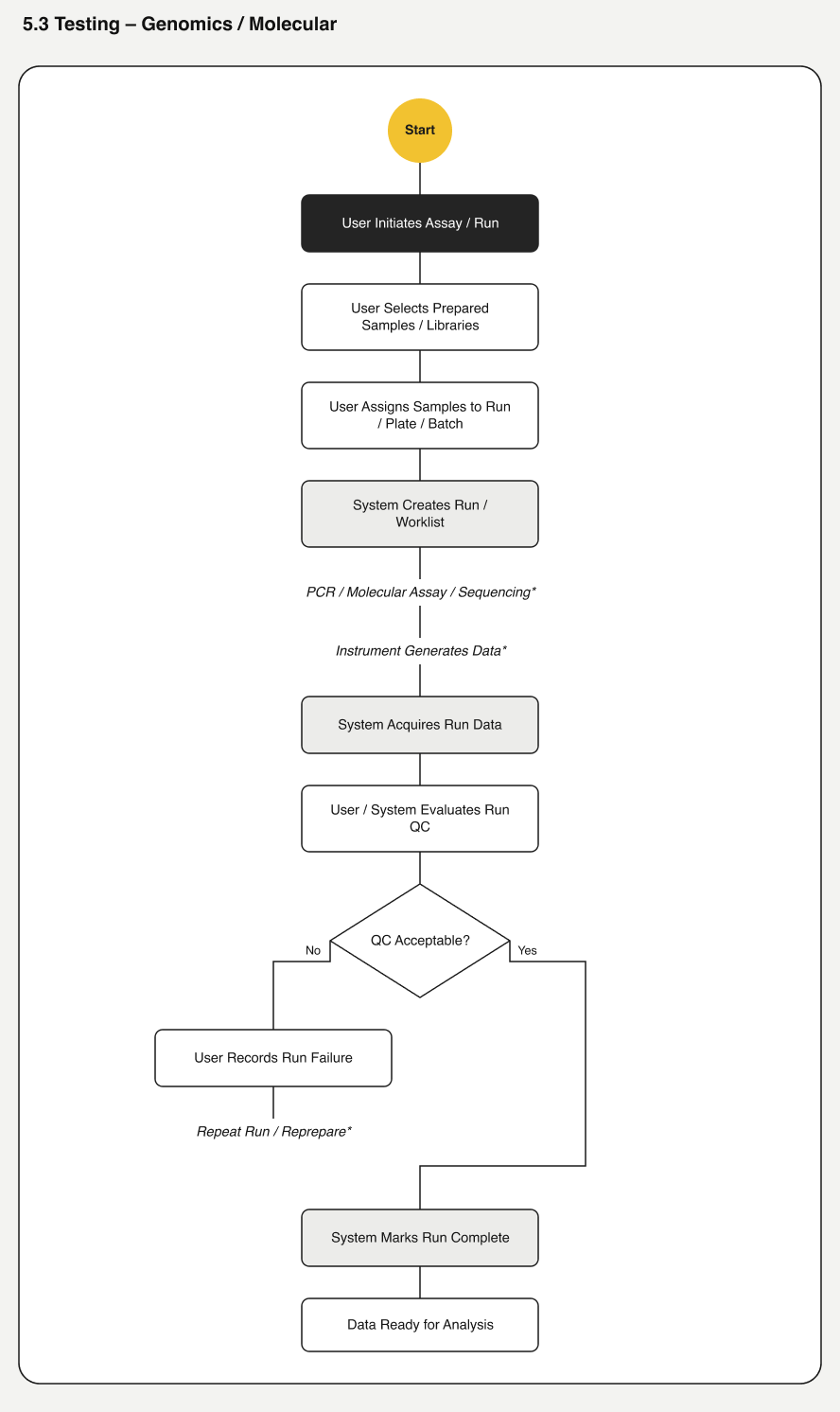
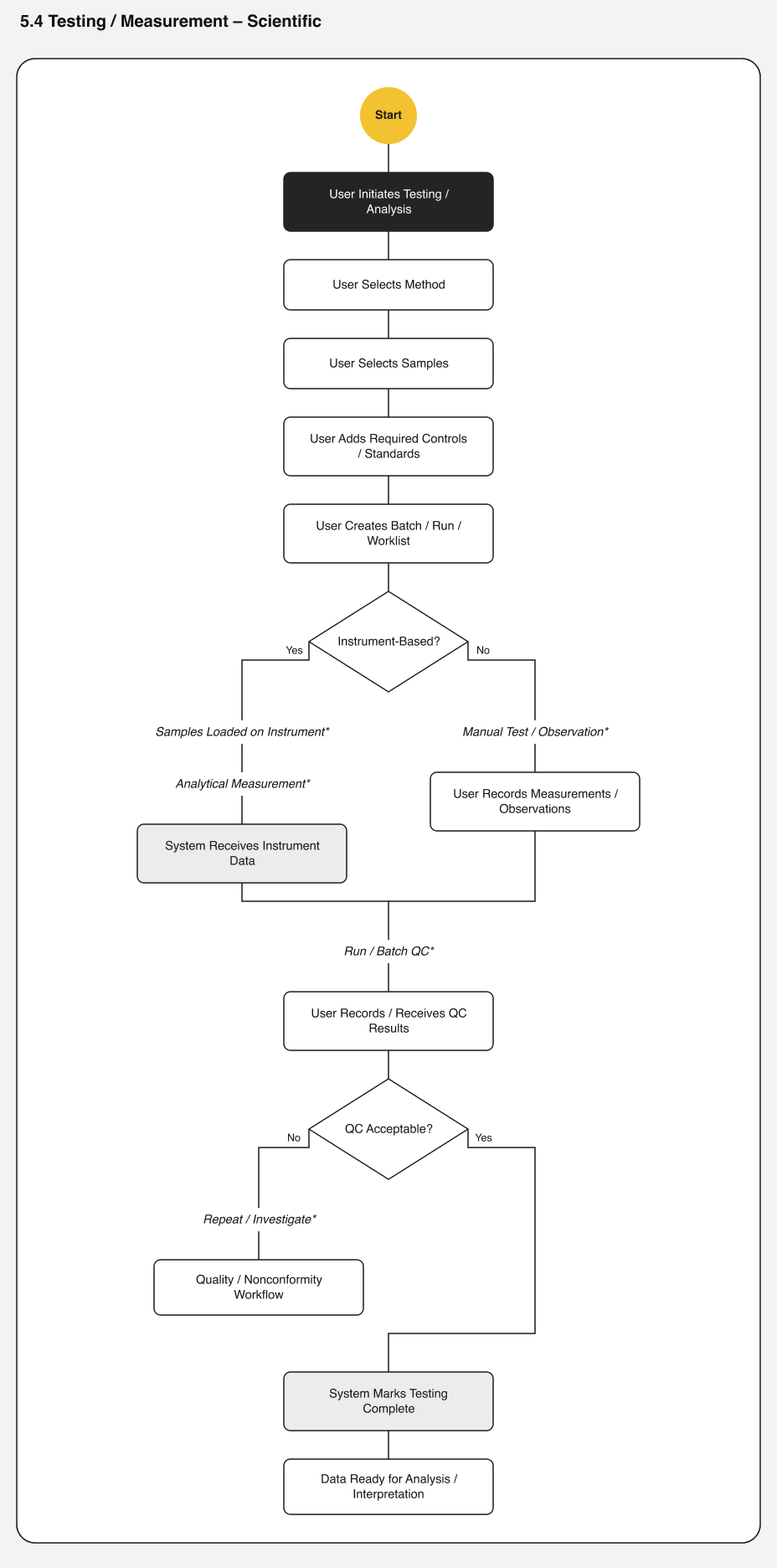
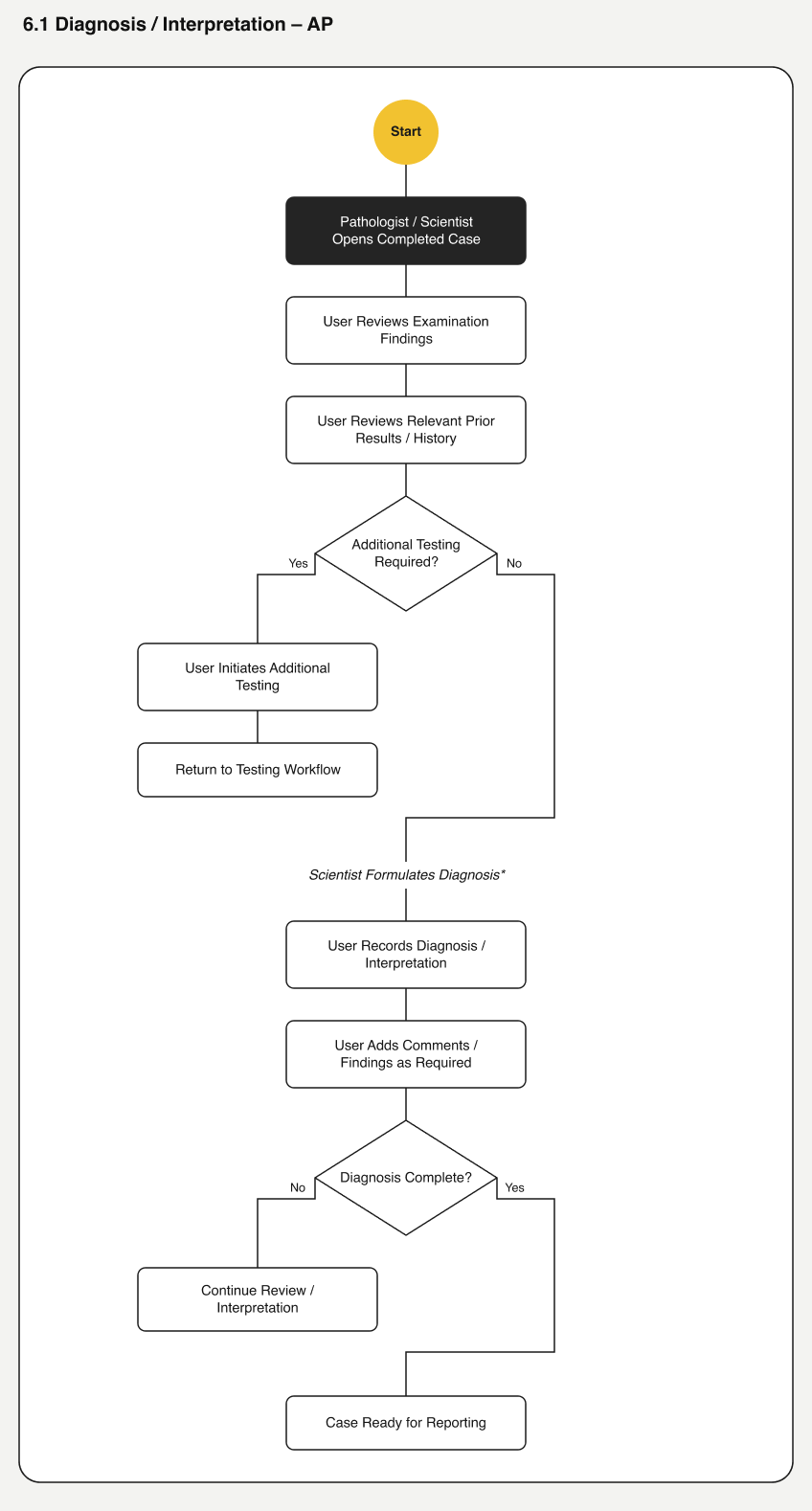
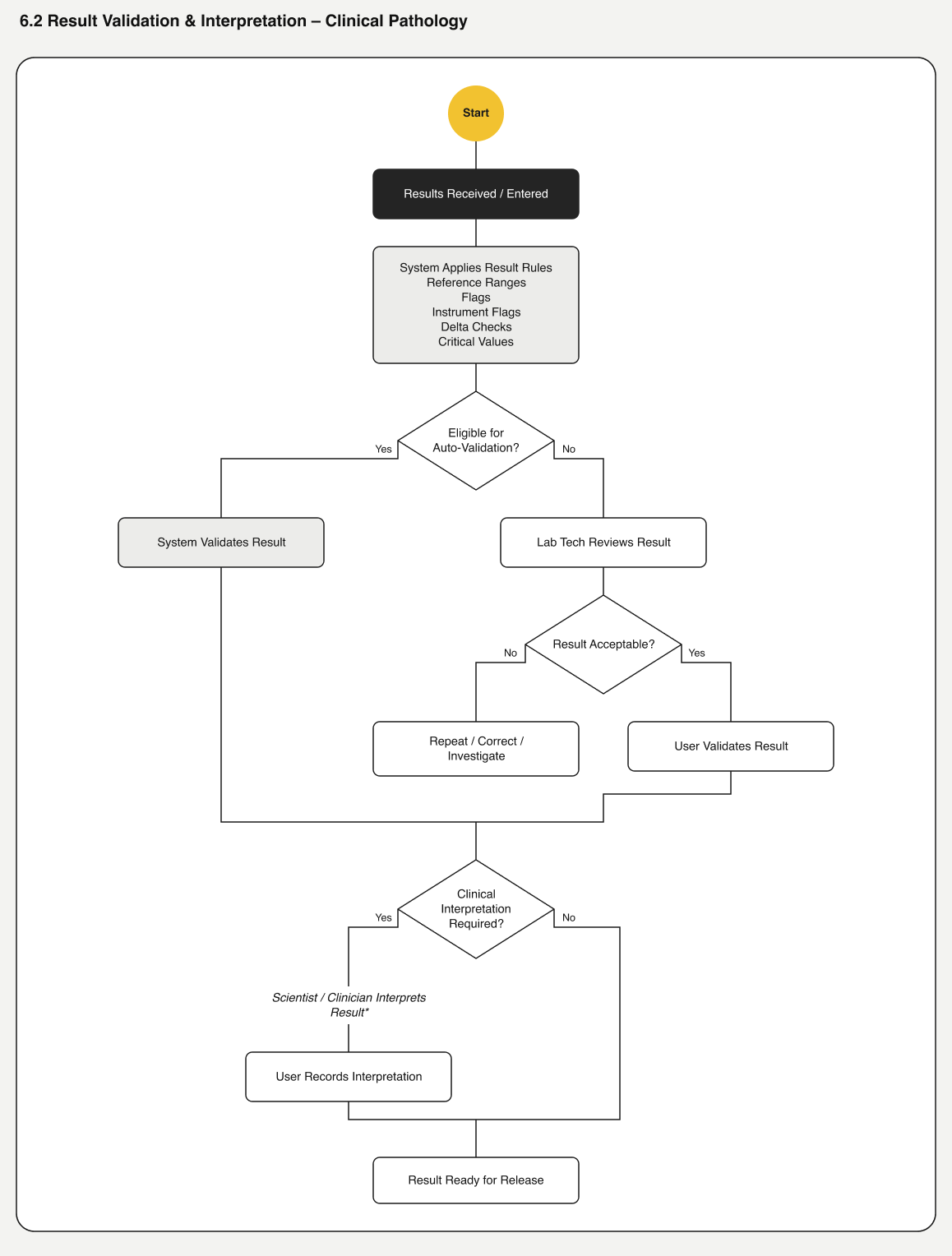
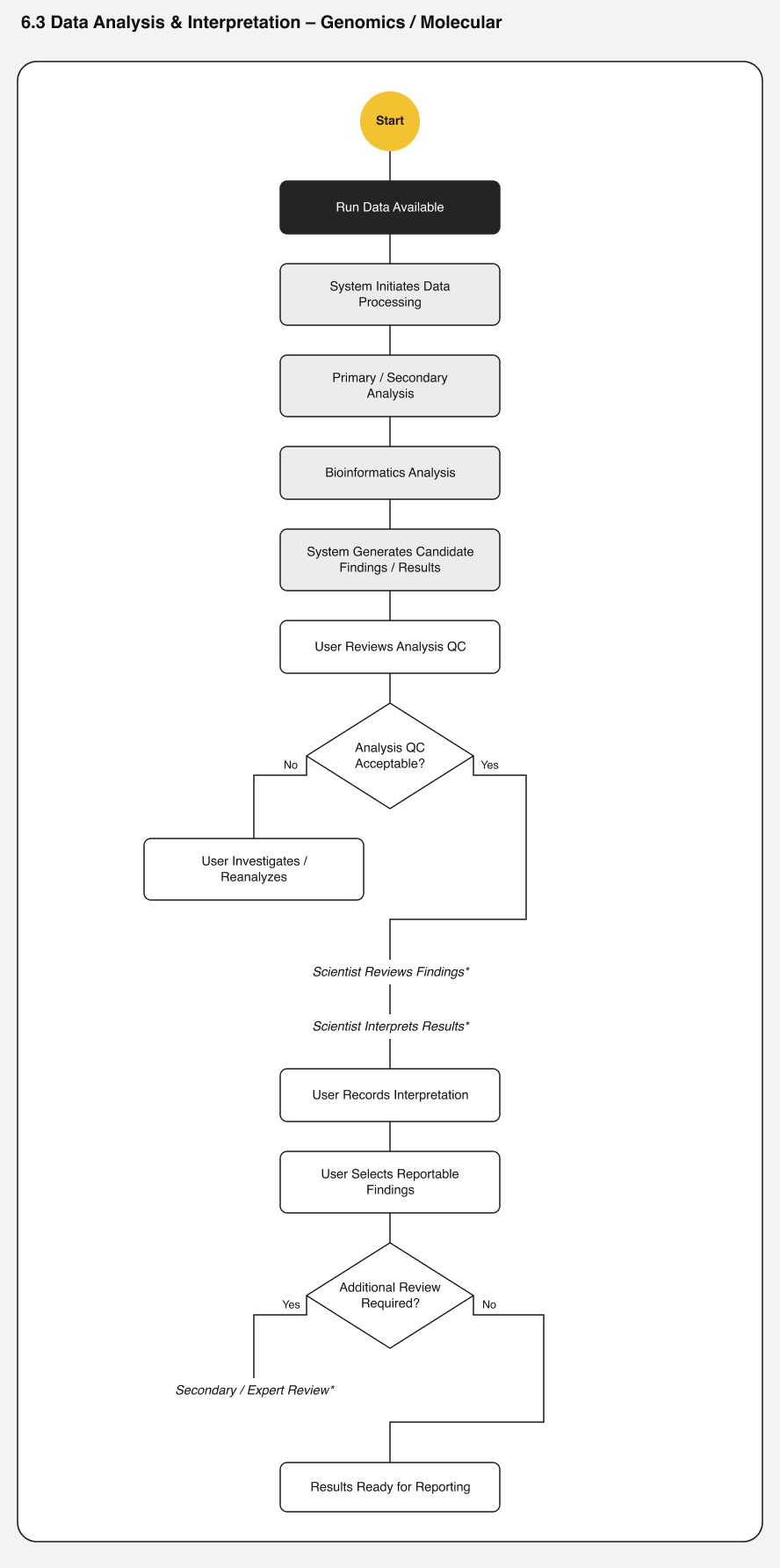
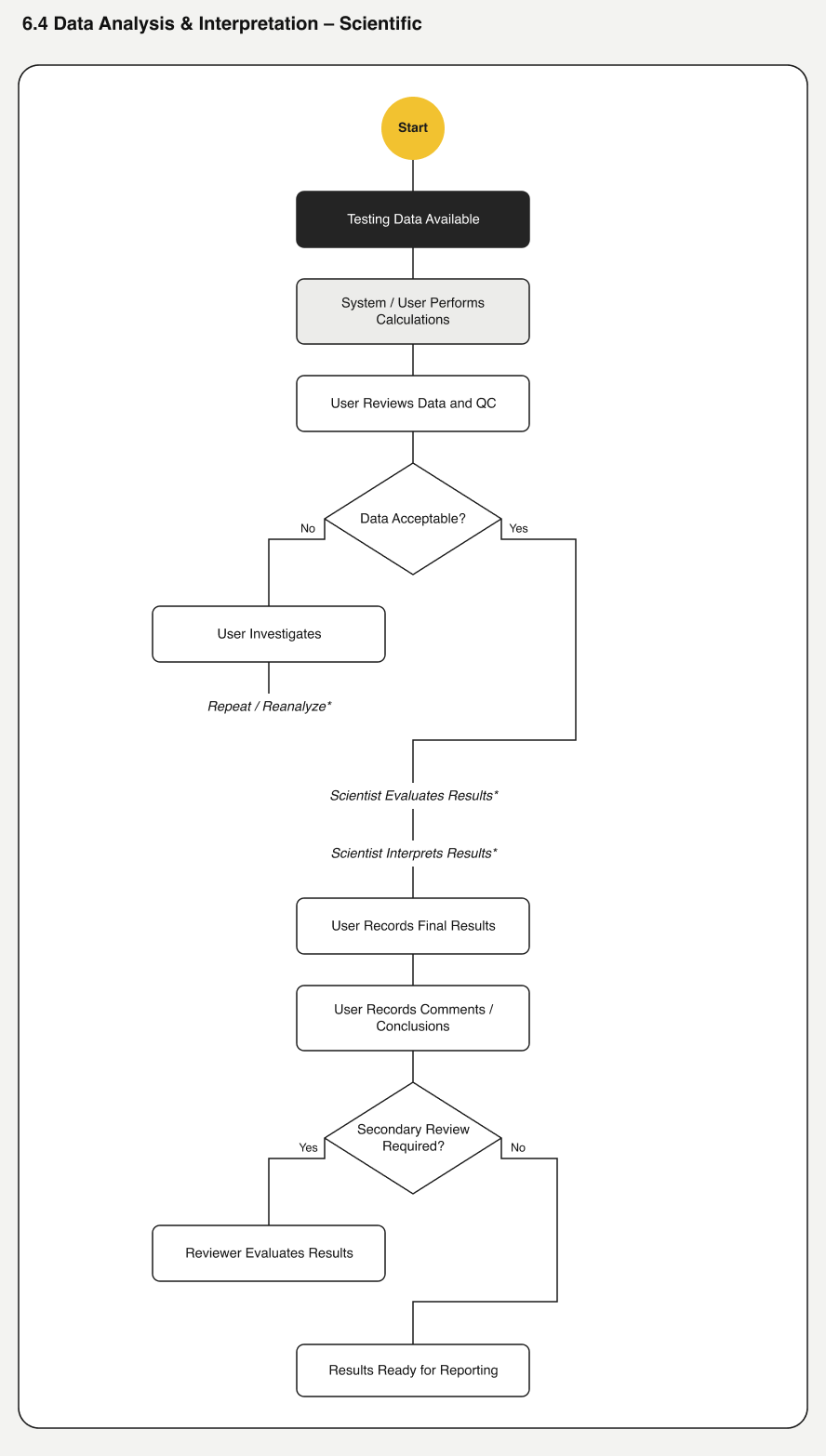
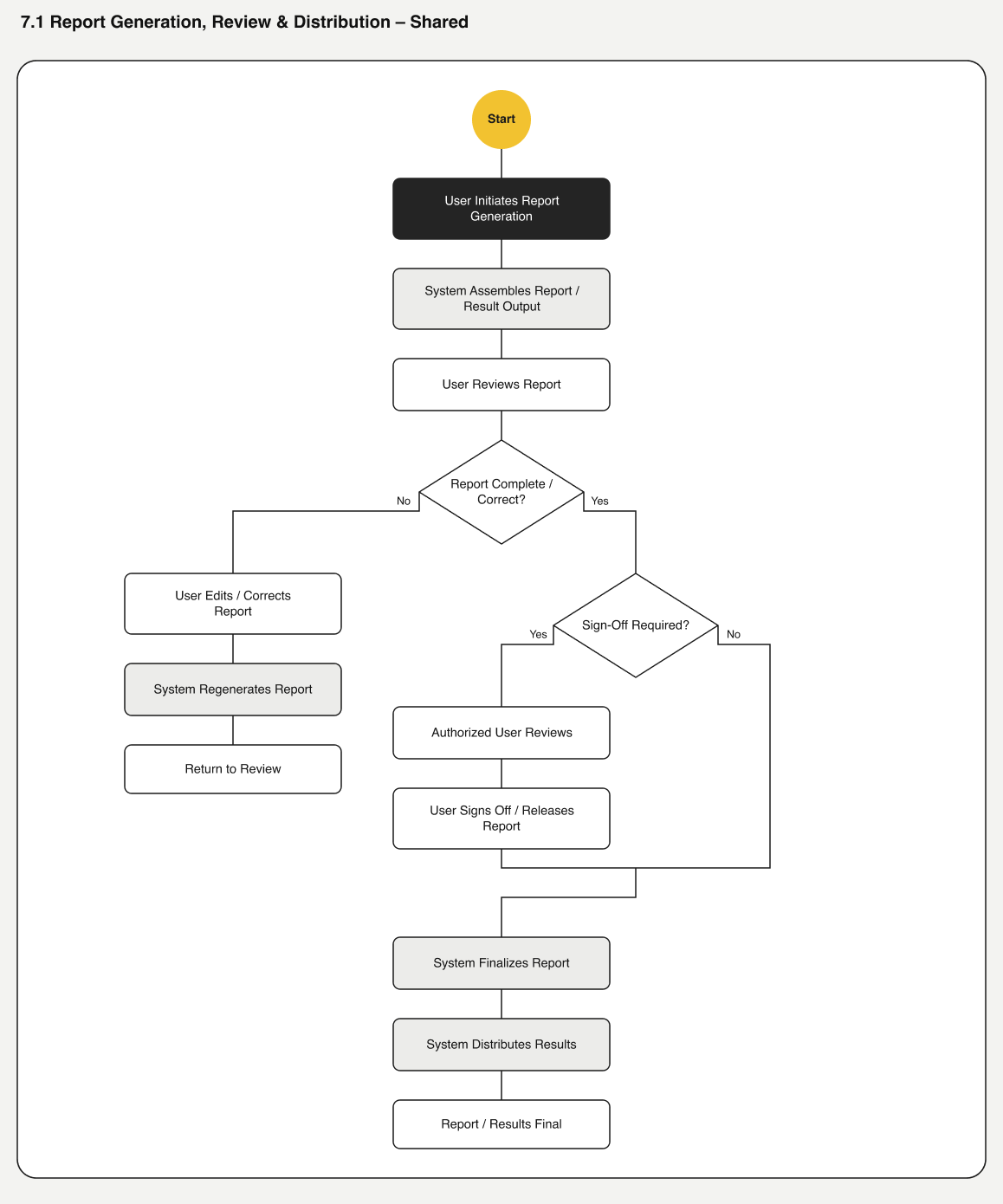
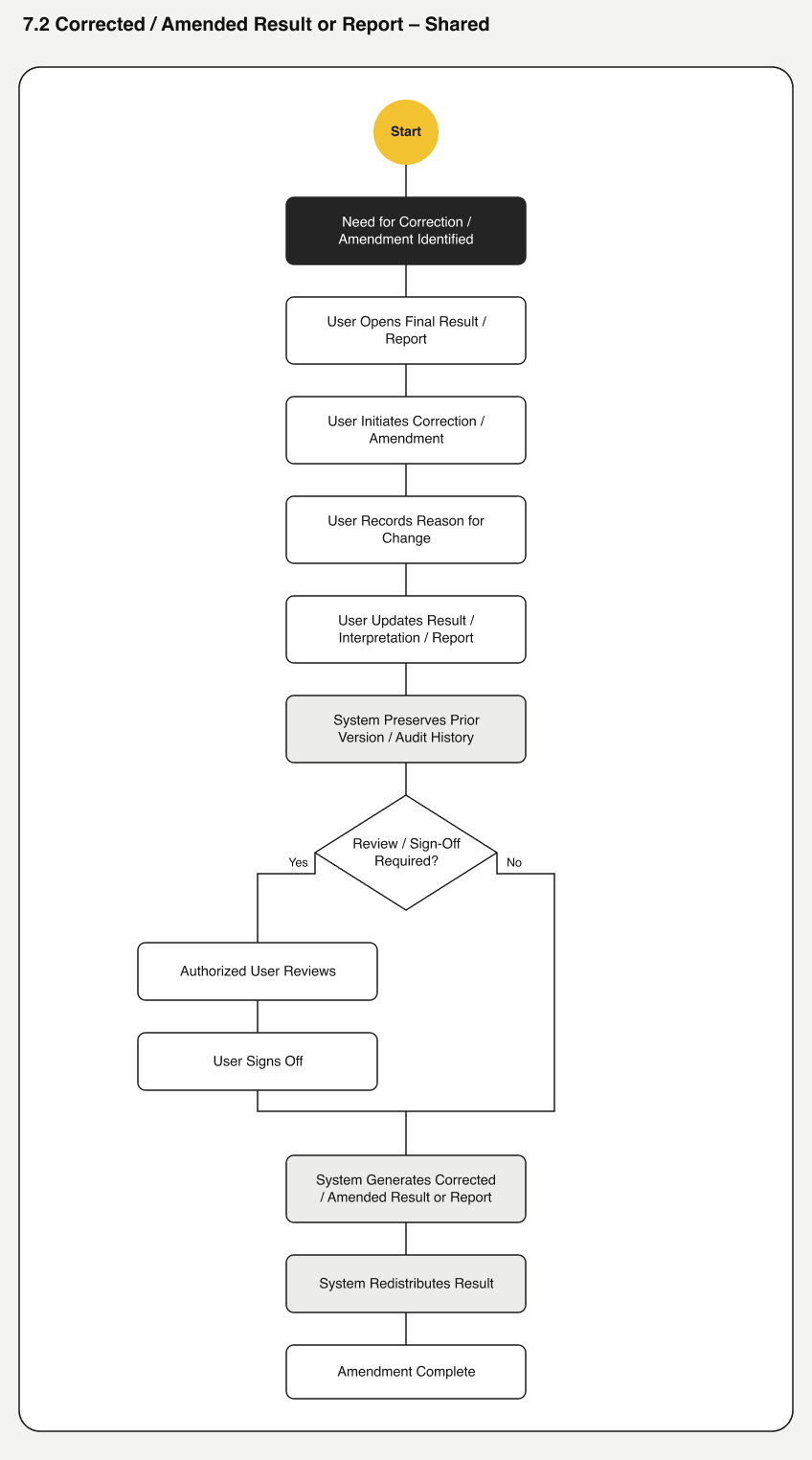
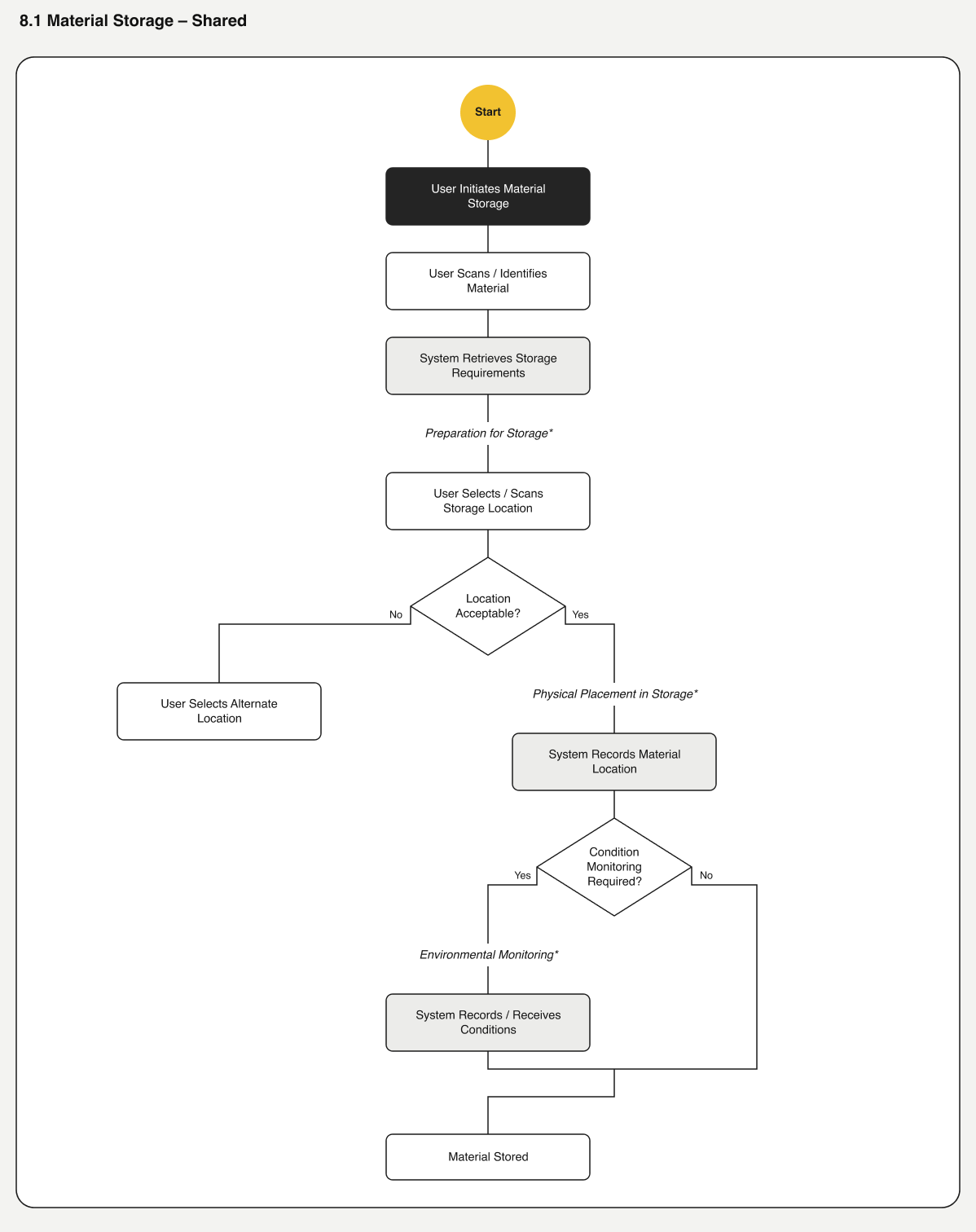
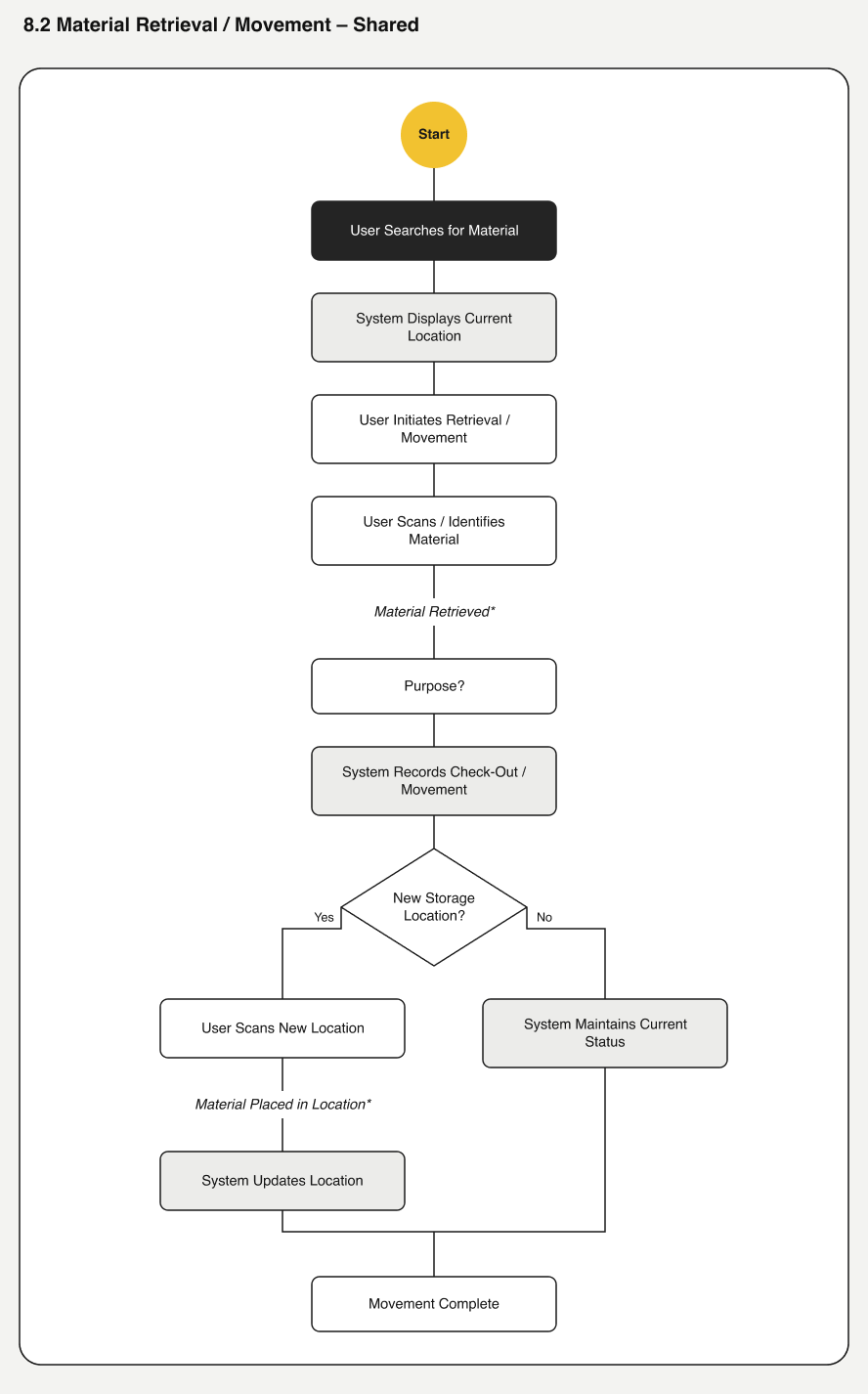
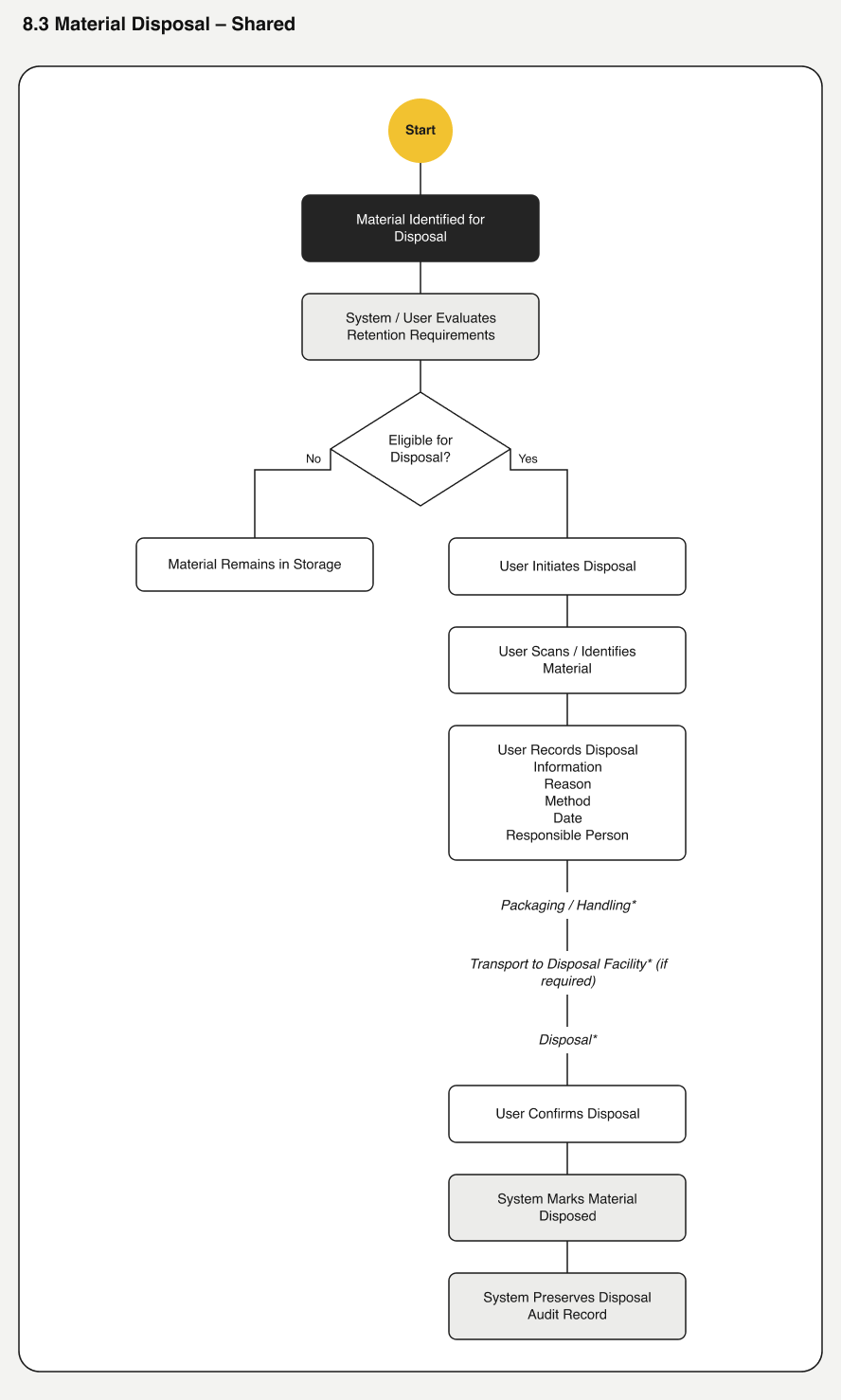
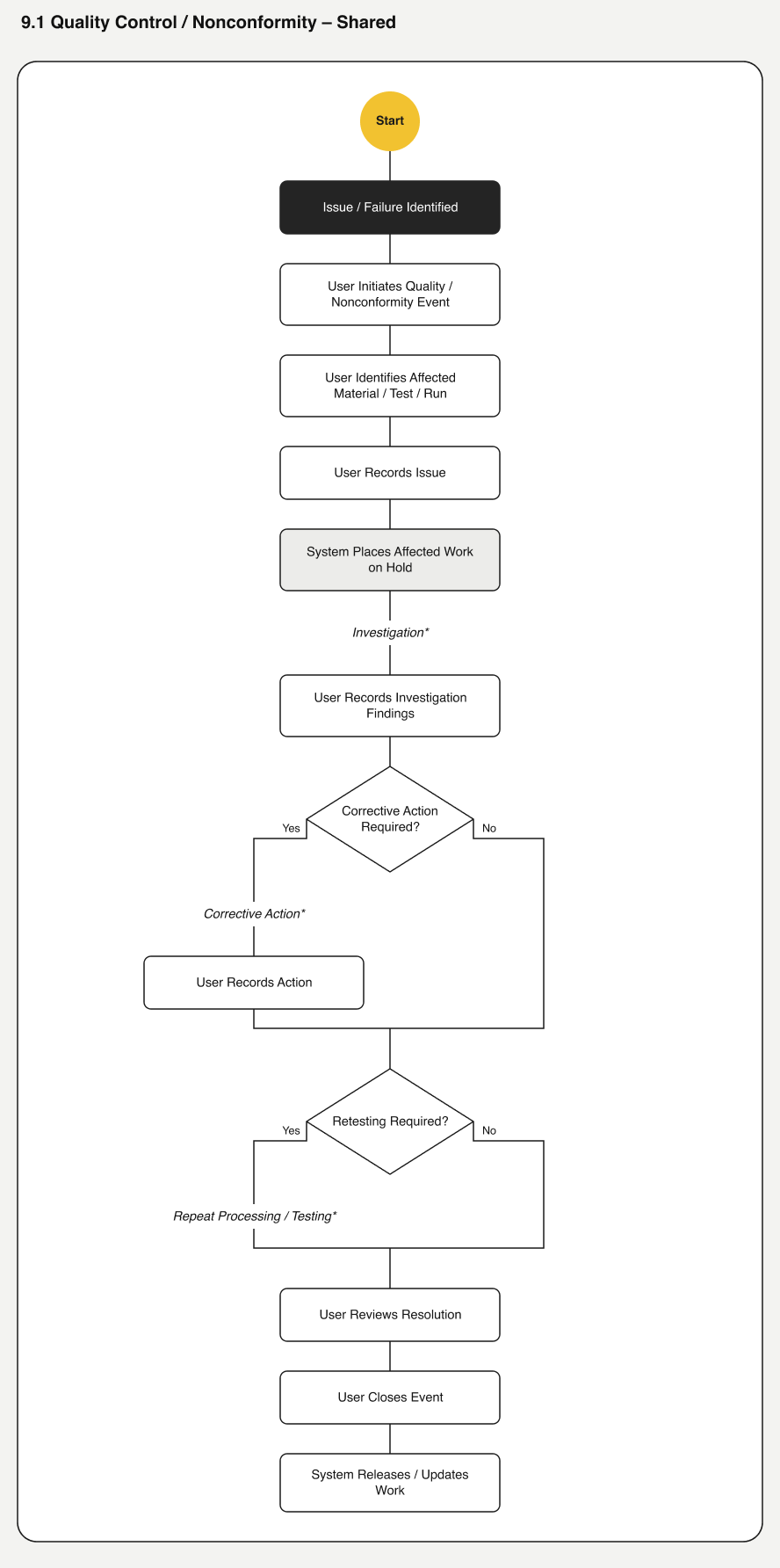
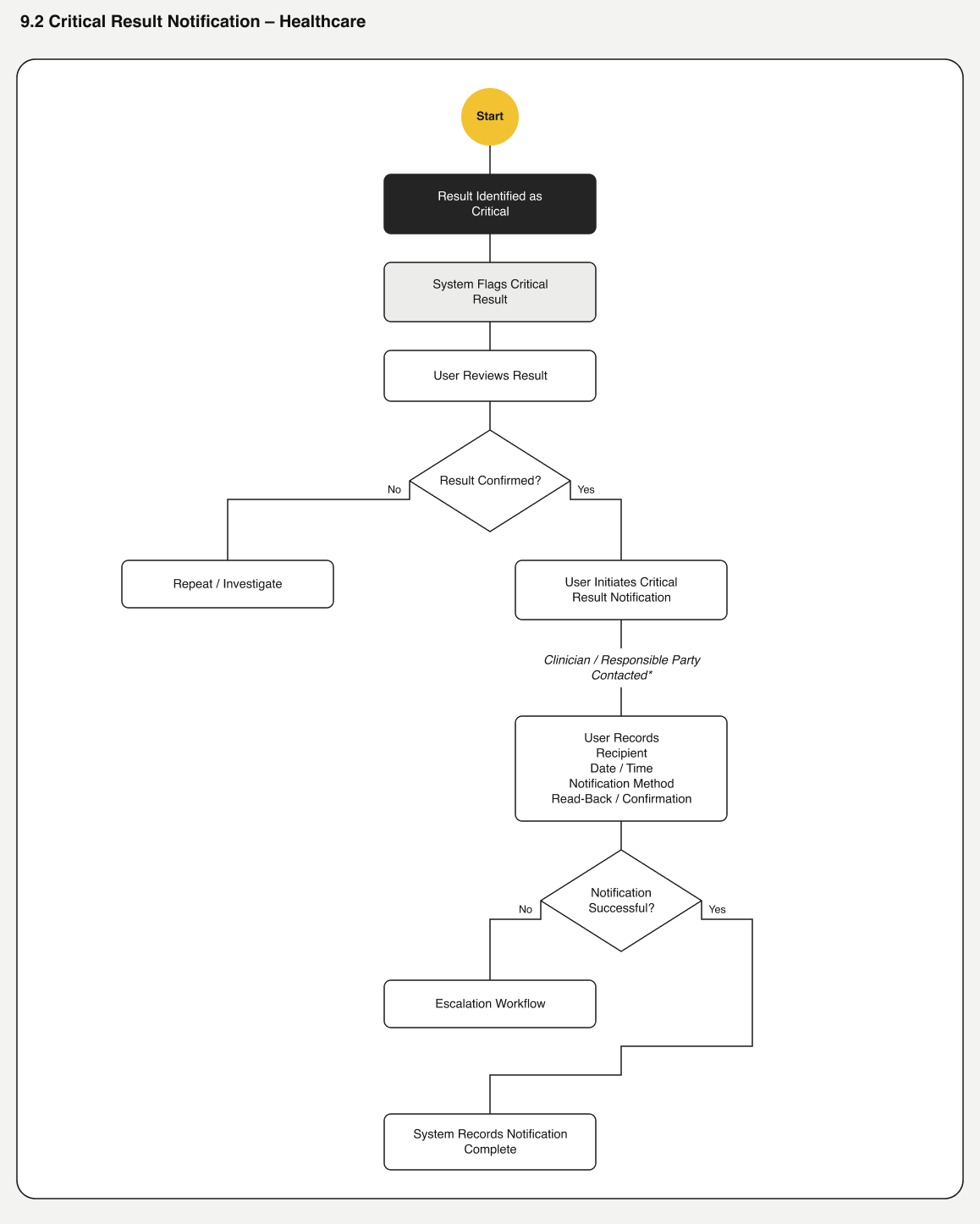
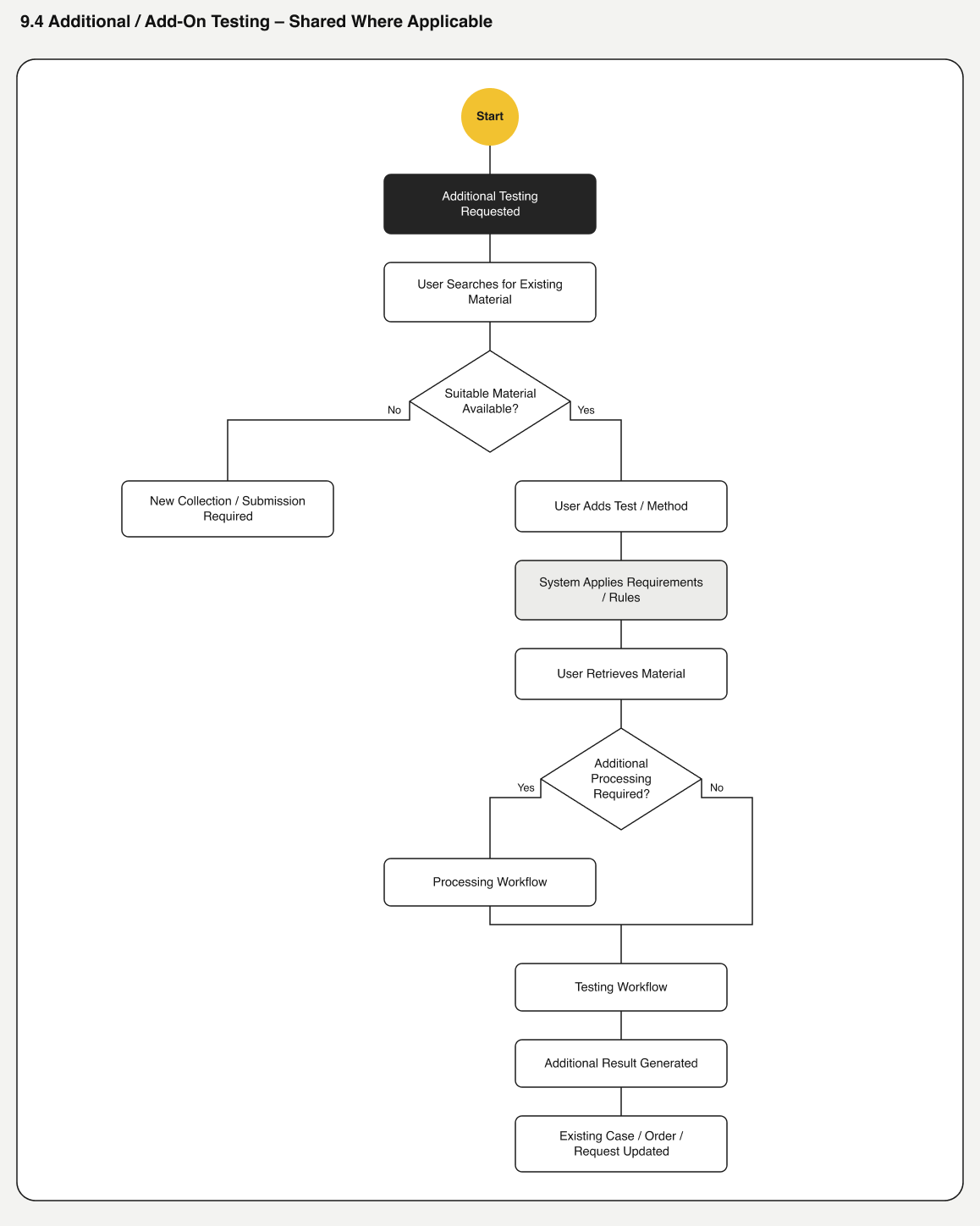
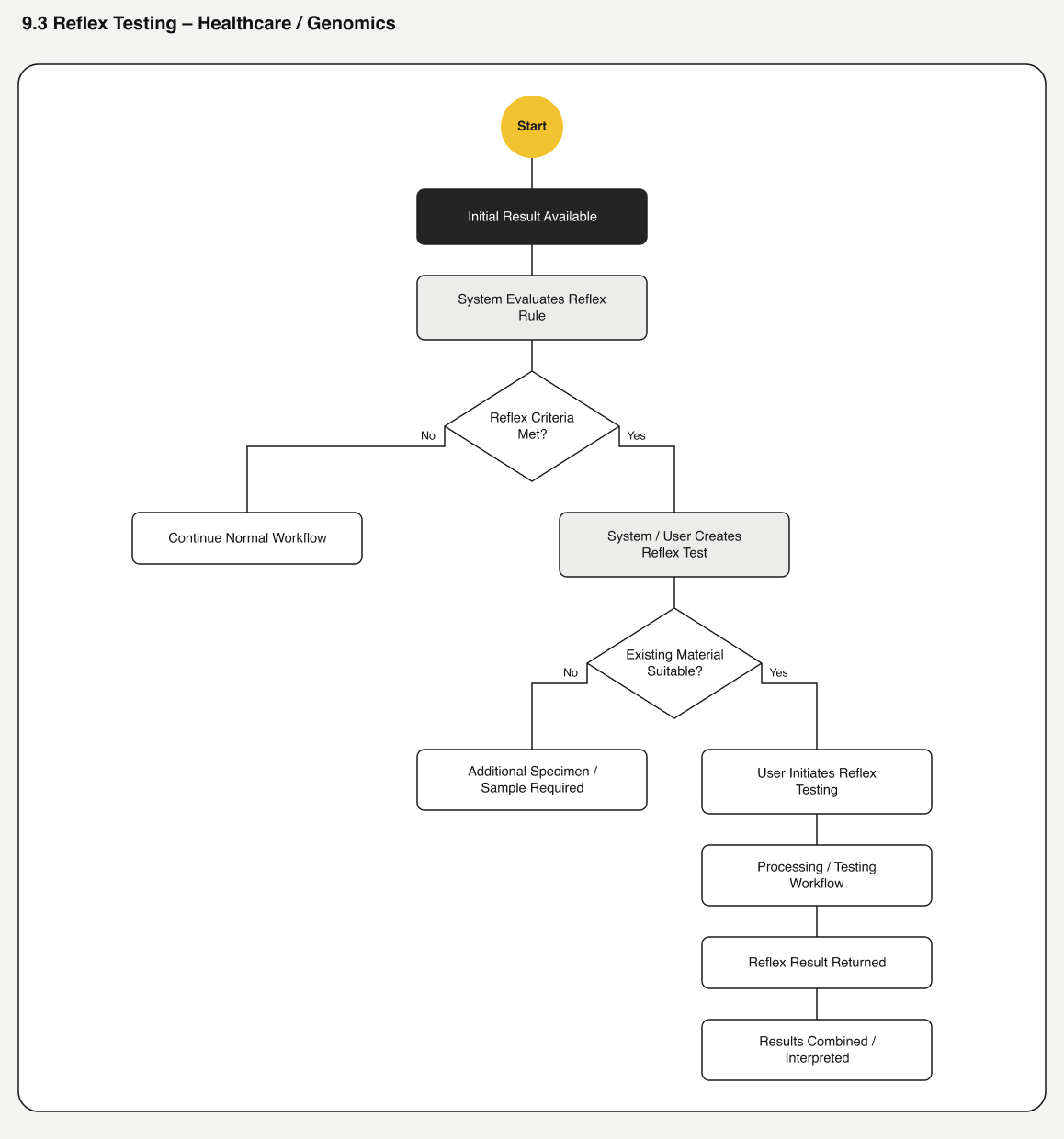
Translating that model into interface behavior produced twenty-nine application flows spanning nine workflow stages, each one deciding, concretely, what's shared and what's discipline-specific. Each stage below shows one representative flow: click any thumbnail to page through every variant.
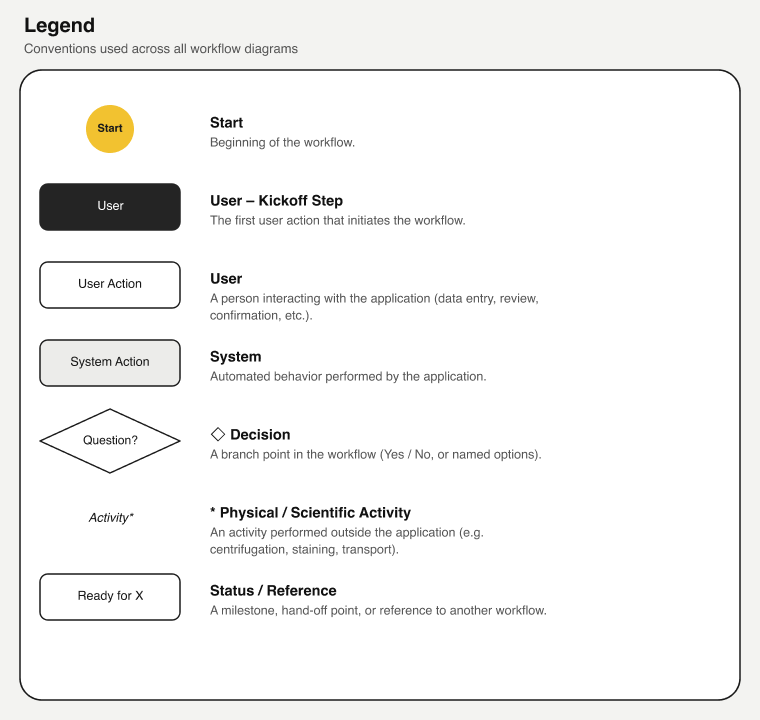
Conventions used across every workflow diagram below: Start, User actions, System actions, decisions, physical/scientific activities, and status hand-offs. Click any diagram to enlarge.
The fourth lens asks what the system needs to provide, independent of who's using it, what it touches, or how the work happens: automation, validation, integrations, permissions, notifications, and traceability, among others. Six capability areas came out of that lens:
Users, roles, permissions, and authorization.
Adapting workflows, terminology, rules, and application behavior.
Connecting instruments, external systems, applications, and services.
Protecting laboratory and sensitive data.
Supporting auditability, quality processes, and regulatory requirements.
Maintaining and managing the application.
UX and product team members each had deep expertise in their own discipline, but little visibility into how other disciplines worked, so capability needs like permissions, configuration, and integrations were often assumed to be discipline-specific by default. That gap showed up concretely in CLS, originally built for scientific disciplines: extending it into healthcare kept surfacing capability gaps that scientific-only design hadn't anticipated, and engineering was frequently looped in only after those gaps caused rework, sometimes requiring a project to restart. Publishing the capabilities research broadly, shared through the team's SharePoint, helped close that visibility gap; the artifacts occasionally turned up in other teams' own presentations.
The framework became the team's standing reference for evaluating shared-versus-specific design decisions going forward, and the twenty-nine application flows gave product and engineering a concrete, discipline-by-discipline starting point for translating that model into CLS's interface behavior, rather than relitigating the shared-vs-specific question from scratch for every new laboratory domain the platform takes on.
Shared versus discipline-specific was never decided at the level of a whole workflow. It was decided flow by flow, sometimes step by step within a single flow. Testing and interpretation diverge sharply by discipline, because that's where the domain expertise actually lives. Collection, reporting, and storage converge, because the underlying operations (receive it, document it, release it, keep it) don't actually depend on what "it" is. The framework's job was to make that distinction legible and repeatable, rather than left to case-by-case debate every time a new domain came up.
This project sits apart from CLS's other case studies: the deliverable wasn't a screen or a prototype, it was a way of thinking that made every subsequent screen decision faster and more defensible. Twelve laboratory domains, sixteen role families, and fifteen workflow models don't reduce to a single interface by accident or by intuition. They reduce to one by first proving, rigorously, where they actually agree.
The most important output wasn't any individual artifact above. It was a repeatable four-lens method for asking "is this shared or specific?" and answering it with evidence instead of assumption, a method built to extend to the next laboratory domain CLS takes on, not just the twelve mapped here.